
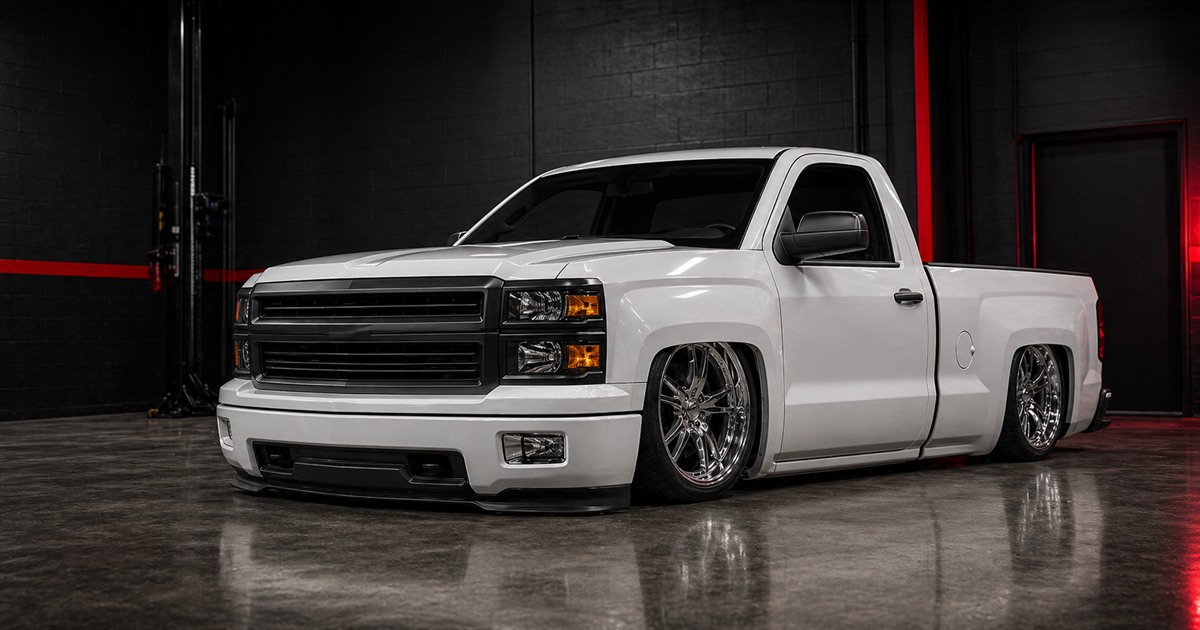
Complete Truck Lowering Guide: Drop Spindles, Coils, Shackles, Flip Kits & More
Posted by Trekline Motorsports on May 6th 2026
Lowering your truck is one of the most impactful modifications you can make. Whether you want to improve handling, achieve a signature stance, or simply change the aesthetic, there are multiple methods to drop your suspension - each with different advantages, challenges, and cost profiles. This guide walks you through every lowering technique used by shops and enthusiasts today, explains the mechanics behind each approach, and helps you plan the perfect build for your goals and budget.
Lowering note: Always match lowering parts to the exact truck platform. Front suspension type, rear leaf/coil layout, brake line routing, shock length, and axle clearance all matter.
For the dollars-and-cents side of each method, pair this guide with our how much it costs to lower a truck breakdown. And if you're going the spindle route, our drop spindle installation walkthrough is the companion you'll want next to you in the garage.
Drop Spindles: The Ride Quality Preserving Method
Drop spindles are among the most popular lowering solutions because they offer a clean, straightforward way to lower the front end while maintaining the original ride geometry. A spindle is the component that connects your wheel hub to your upper and lower control arms. Stock spindles have a specific height and steering axis angle. A drop spindle changes the wheel mounting position so the hub sits higher relative to the ball-joint locations, which lets the truck body and frame sit lower over the same wheel.
The beauty of drop spindles lies in what they preserve. Because you're not changing spring rates, control arm angles, or bump stop clearances, your truck's suspension geometry stays largely intact. Your ride quality remains comfortable, and steering feel doesn't suffer the way it might with coil drops or air ride alone. A typical drop spindle gives you 2 to 3 inches of front drop, with 2 inches being the sweet spot for most applications.
Mechanically, here's what's happening. Your stock spindle has upper and lower ball joint bosses at specific spacing. The drop spindle places the hub/wheel mounting point higher relative to those ball-joint locations. The wheel sits at the same angle, your spring compresses the same way, and the truck body and frame sit lower relative to the wheel. Since your springs still work in their original range and your control arms still operate close to their designed angles, ride quality and travel are usually preserved better than with a spring-only drop.
One advantage of drop spindles is that they pair well with many other lowering methods when the parts are matched correctly. You can often use a drop spindle for front drop, then add coils, control arms, or another application-specific part for additional height change, but the final combination still needs alignment, wheel clearance, brake hose routing, and shock travel checks. Installation typically requires removing the wheel, caliper, rotor, and hub assembly, then swapping the spindle. It's a moderate DIY job for someone with suspension experience, or a straightforward job for a shop - see our step-by-step drop spindle install guide.
For classic trucks like 73-87 C10/C15 C1500, we offer two drop-spindle options - one for trucks running 1.25" rotors and one for 1.00" rotors - so you can match your existing brake setup. Across the OBS generation (88-98), Trekline covers C1500 2WDs with three rotor- and cab-specific 2" drop-spindle kits so whichever OBS C1500 you own has a drop-in match.
73-87 C10/C15 C1500 3" Drop Spindles (1.25" rotors): SKU 8000100 - $250
73-87 C10/C15 C1500 3" Drop Spindles (1.00" rotors): SKU 8000101 - $250
88-91 C1500 Standard Cab (1" rotors) 2" Drop Spindles: SKU 8000102 - $269
88-98 C1500 (1.25" rotors, excl. 88-91 Std Cab) 2" Drop Spindles: SKU 8000103 - $269
Drop Coils: Shorter Springs for Adjustable Front Drop
Drop coils are shorter coil springs designed to lower the front of the truck. Depending on the suspension design, the coil may sit in a control arm pocket, spring pocket, or strut-style assembly. A 2-inch drop coil is designed to lower the vehicle about 2 inches, but the final height can vary with engine weight, cab configuration, accessories, and the condition of the rest of the suspension.
Drop coils are useful because they can be combined with other lowering parts. For example, a truck may use drop spindles up front for ride quality and a mild drop coil for additional height reduction. The rear may use shackles, hangers, a flip kit, or other parts depending on the platform.
The trade-off is that a shorter spring can reduce available suspension travel. Some lowering springs are stiffer than stock and some use a progressive rate, so ride quality depends on the spring design, shock choice, truck weight, and how low the build goes. When selecting drop coils, verify engine size, drivetrain, cab style, and intended use.
Installation usually requires safely unloading the spring and removing front suspension parts. Coil springs store a lot of energy, so this is not a beginner job without the correct tools and experience.
88-98 C1500 V8 2WD 2-inch front drop coils are one example of a common Trekline front lowering spring option.
Flip Kits: Maximum Instant Rear Drop
If you want a major rear drop on a leaf-spring truck, a flip kit is one of the most common methods. A flip kit relocates the rear axle from below the leaf springs to above the leaf springs, which lowers the truck body and frame relative to the axle and wheels. Most flip kits create roughly 5 to 7 inches of rear drop depending on the truck and the kit design.
The leaf springs still support the truck, but the axle-to-spring relationship changes. The kit may include axle saddles, plates, U-bolts, shock relocation brackets, lift/hanger components, or other hardware depending on the application. Proper U-bolt torque is critical because loose or uneven U-bolts can let the axle shift on the leaf springs.
A flip kit does not usually lower the rear differential housing closer to the ground by itself. The axle and differential remain at the wheel centerline. What changes is the height of the frame, bed, bumper, exhaust, and body relative to the axle. That means frame-to-axle clearance, driveshaft clearance, exhaust clearance, brake hose routing, and shock travel all need to be checked.
Pinion angle can also change with a flip kit. Some trucks require shims or other correction parts to avoid vibration. Deep rear drops often require a C-notch so the axle can move upward without hitting the frame.
Examples include Trekline’s 07-13 Silverado/Sierra 1500 5-6 inch rear drop axle flip kit with lift hanger and replacement U-bolts for flip kits.
C-Notch: Essential for Deep Rear Drops
When the rear of a truck is lowered several inches, the axle gets closer to the frame rails during suspension compression. A C-notch creates additional frame clearance above the axle so the suspension can move without the axle hitting the frame.
A C-notch does not simply “cut out a crossmember.” A proper kit removes a controlled section of the frame rail above the axle and reinforces that area with a formed or boxed notch. The goal is to gain axle clearance while maintaining frame strength.
A C-notch is commonly needed or strongly recommended when using a flip kit, air suspension, or any deep rear drop where frame-to-axle clearance becomes limited. Without enough clearance, the truck can bottom out harshly, damage bump stops, contact the frame, or ride poorly.
There are bolt-in and weld-in C-notch designs. A bolt-in notch can be faster and cleaner for some street builds, while a weld-in notch is more permanent and depends heavily on weld quality and reinforcement. Any frame modification should be handled by someone with the right tools and experience.
Example kit: 73-87 C10/C15 3/6 coil drop kit with shocks and C-notch.
Critical: Do not attempt a C-notch installation without proper equipment and experience. Frame modifications affect chassis strength and safety.
Drop Shackles: Simple and Affordable Rear Lowering
Drop shackles are one of the simplest and most affordable rear lowering methods for many leaf-spring trucks. The shackle connects the rear of the leaf spring to the frame. A lowering shackle is usually longer and/or shaped differently so the frame sits lower relative to the rear spring and axle.
The advantage is simplicity. Most drop shackle installs do not require cutting or welding, and they are often reversible. They are a good choice for a mild rear drop or for fine-tuning stance after the front has been lowered.
The trade-off is limited drop. Where a flip kit may create a large rear drop, shackles are usually in the 1- to 2-inch range depending on the part and the truck. They can also change rear spring angle slightly, so inspect shackle clearance, bed support clearance, and rear shock travel after installation.
Example: 88-98 C1500/K1500 1- or 2-inch rear lowering drop shackles.
Drop Control Arms: Maximum Front Drop Control
Drop control arms can lower the front end more aggressively than spindles alone on some platforms. These are replacement upper and/or lower control arms built with application-specific geometry, such as different spring-pocket, ball-joint, or arm-position relationships, to lower the chassis while keeping alignment and suspension travel manageable. Unlike drop spindles, control arms can change the suspension's operating angle, so they need to be matched carefully to the truck and drop amount.
You can install drop control arms in several configurations. Some trucks benefit from dropping the lower arms and using alignment correcting uppers. Some kits drop the lower arm significantly while keeping the upper stock. The specific setup depends on your truck's architecture and your target drop amount. A quality drop control arm kit is engineered to maintain bump stop clearance, correct geometry, and acceptable caster and camber angles.
Drop control arms can be part of a more aggressive front drop on platforms where the arm geometry is designed for that purpose. They are often used when a spindle-only or coil-only setup cannot provide the stance, alignment range, ball-joint angle, or suspension travel the build needs. They can also work with air ride or coilover-style builds, but they do not create unlimited usable height range by themselves. The arms, springs or bags, shocks, bump stops, steering clearance, and alignment all have to work together.
Installation requires removing wheels, disconnecting sway bars, and unbolting the ball joints from the existing arms. You then install the new control arms and reconnect everything. Alignment is critical after control arm installation - caster, camber, and toe must be checked and adjusted. Factor in alignment costs when budgeting for control arm work.
99-06 Silverado/Sierra 1500 3"/5" Control Arm (Lower Arms) Drop Kit: SKU 1400DR10061 - $536
Air Ride Suspension: Wide Height Adjustability
Air ride systems use airbags in place of or alongside the original spring setup, depending on the vehicle and kit design. A compressor charges the bags, and a management system (mechanical valves or electronic controller) controls pressure and ride height. Air ride gives you a wide adjustable height range - often low for shows and higher for driveway, road, or loading clearance - but the usable range depends on the chassis setup, suspension geometry, shock travel, and installed components.
The mechanics are straightforward in concept. Airbags are reinforced rubber-and-fabric springs that may replace or supplement the original springs depending on the kit. As pressure increases, the bag supports more load and changes ride height. A compressor and tank or other air source fill the system. A management system is mounted in a protected location and distributes air to the bags based on demand. Many modern electronic management systems can raise or lower all four corners independently.
The advantages of air ride are obvious: adjustable height, flexible stance control, and the ability to tune the truck for different situations when the system is built correctly. However, there are trade-offs. Air ride systems are expensive, often $3,000-$8,000 installed. Ride quality depends on bag pressure, shock choice, suspension geometry, and install quality. They also require maintenance - compressors, fittings, lines, bags, valves, sensors, and electronic controllers should be inspected regularly. If a major air-system problem happens on the road, the truck may lose ride height, so many air suspension owners carry basic repair parts and have a plan for getting home safely.
Air ride typically requires that you also install drop spindles or control arms up front, and a flip kit or replacement leaf springs in the rear. The airbags supplement these changes to achieve your target height and provide adjustability.
Torsion Key Quality on Torsion-Bar Trucks
If you are working on a torsion-bar truck, the keys deserve attention. Many 4WD GM trucks use torsion bars up front, and some platforms use lowering keys to re-index the torsion bar adjustment point for a lower ride height.
For 88-98 GM trucks, torsion bars are associated with the 4WD K-series front suspension, not the 2WD C1500 coil-spring front suspension. Always verify the truck’s drivetrain and front suspension before ordering torsion-key parts.
Forged keys are generally preferred for strength and consistency under repeated suspension loads. Our forged vs cast torsion keys comparison explains why material quality matters.
Common Lowering Recipes: Build Combinations
You do not have to choose just one lowering method. Most complete builds combine front and rear parts to achieve a balanced stance. These are general recipes; the exact parts depend on the truck platform.
2" Front / 2" Rear Drop (Mild Stance)
Front: drop spindles or drop coils, depending on the truck. Rear: drop shackles, hangers, or a mild rear drop part. This is a good daily-driver style drop because it keeps the truck usable and does not usually require major frame work.
3" Front / 5" Rear Drop (Aggressive Stance)
Front: drop spindles plus drop coils or another application-specific front setup. Rear: flip kit, sometimes with hangers/shackles depending on the kit. Brake hose routing, shock length, pinion angle, bump stop clearance, and frame-to-axle clearance should all be checked. A C-notch may be recommended or required on some trucks.
4" Front / 6" Rear Drop (Extreme Stance)
Front: drop spindles, drop coils, control arms, or a complete front lowering setup depending on the truck. Rear: flip kit plus C-notch and matched shocks. This level of drop should be treated as a system, not a mix of random parts.
Air Suspension Builds
Air suspension adds height adjustability, but it is also the most involved option. A proper air system needs correct bag placement, air management, compressor mounting, line routing, electrical work, shock travel, bump stops, and frame clearance. These builds should be planned and installed by experienced shops.
Safety Considerations Every Lowering Build Needs
Lowering your truck safely requires attention to several areas. Brake hose routing is one of the biggest. Hoses must not stretch at full droop, kink at compression, rub the tire, or get pinched by suspension movement. Some deep-drop builds require brake hose relocation or extended lines.
Bump stops also matter. When a truck is lowered, the suspension has less room to compress before parts make contact. Bump stops should be positioned and trimmed correctly for the kit so the truck does not bottom out metal-to-metal.
Exhaust clearance becomes more important on a low truck. Pipes, mufflers, hangers, and tailpipes that cleared easily at stock height may contact the axle, frame, driveshaft, or pavement after lowering.
Driveshaft angle and pinion angle should be checked, especially with flip kits and deep rear drops. Vibration after lowering is often a sign that the driveline angle needs attention.
Alignment is required after front-end lowering work. Drop spindles may preserve much of the factory geometry, but toe, camber, and caster still need to be checked after installation. Rear-only shackle or flip-kit work may not change front alignment, but the complete truck should still be inspected before regular driving.
Important: Lowering changes ground clearance, approach angles, suspension travel, and sometimes brake hose or driveline routing. Safety checks are not optional.
Tools and Equipment Needed for Installation
The tools required depend on which lowering method you choose. A simple shackle replacement needs only basic hand tools. A full suspension overhaul requires professional shop equipment. Here's what you'll need for typical lowering jobs.
Basic drop shackles or spindle swap: jack and jack stands (minimum 6-ton capacity), metric and standard socket set, breaker bar for tight fasteners, torque wrench (for critical fasteners), wire or rope to hang calipers (safety), and penetrating oil (PB Blaster or equivalent).
Drop coil or control arm installation: everything above, plus a spring compressor (coil compression), ball joint separator or puller tool, control arm removal tool (optional but useful), and alignment machine or alignment shop access.
Flip kit or C-notch work: everything above, plus a MIG welder and safety equipment (C-notch only), metal cutting tools (plasma cutter or angle grinder), correct U-bolt torque specs for your application, and brake line flaring tools and materials if extending lines.
When to DIY vs. When to Call a Shop
Drop shackles can be a reasonable DIY job for someone with a safe workspace, jack stands, and basic mechanical experience. Drop spindles require more skill because you are working around steering, brakes, bearings, and ball joints. Our drop spindle installation guide explains the general sequence, but you still need the service manual torque specs for your truck.
Drop coils, flip kits, control arms, and deep rear drops are better suited for experienced installers. Coil springs can be dangerous when compressed. Flip kits require correct U-bolt torque, pinion angle checks, shock travel checks, and brake hose routing. C-notches involve frame modification and should be handled by a qualified shop.
Air suspension should be installed by a shop that understands air management, suspension geometry, electrical routing, and safe fail-safes. A poor air install can create leaks, uneven ride height, or unsafe suspension travel.
Frequently Asked Questions
Can I lower my truck without affecting ride quality?
You can keep ride quality close to stock with the right parts, especially mild drop spindles and matched shocks. Bigger drops, short springs, poor shock choice, or limited bump stop clearance can make the ride harsher.
Will lowering my truck hurt its resale value?
It depends on the buyer. A clean, well-documented lowering job can appeal to enthusiasts, but it narrows the market compared with a stock truck. Reversible parts are easier to explain than permanent frame modifications.
What's the difference between a weld-in and bolt-in C-notch?
A bolt-in C-notch uses hardware and formed plates to reinforce the frame after the notch is cut. A weld-in notch is welded into the frame and depends heavily on weld quality and reinforcement. Either style must be installed correctly.
Do I need an alignment after lowering?
Yes, after front-end lowering work. Drop spindles, coils, control arms, and other front changes should be followed by an alignment. Rear-only work may not require a front alignment, but the truck should still be checked for tracking, vibration, and clearance.
How low can I go without major frame modifications?
A mild front and rear drop is usually possible without cutting the frame, but the safe limit depends on the truck. Deep rear drops, flip kits, and air builds often need a C-notch or other clearance work.
Is air suspension reliable for daily driving?
A well-installed air system can be daily driven, but it has more parts to maintain than a static spring setup. Inspect bags, lines, fittings, compressor operation, electrical connections, and ride height sensors or switches regularly.
Can I combine different lowering methods on the same truck?
Yes. Most complete lowering kits combine methods. The important part is making sure the final geometry, shock length, brake hose routing, bump stops, and tire clearance all work together.
What tools do I really need to lower my truck myself?
At minimum, you need a safe work area, quality jack stands, a floor jack, hand tools, a torque wrench, and the vehicle service information. Some jobs require a spring compressor, ball joint separator, brake tools, or welding equipment. Do not improvise around loaded springs or frame cutting.
Get Your Lowering Components from Trekline Motorsports
Trekline Motorsports has assembled lowering kits for 20+ years. We assemble kits carefully and ship many in-stock orders within 1 business day. Questions about which setup is right for your truck? Email us at info@treklinemotorsports.com.