
How to Install Drop Spindles on a Truck
Posted by Trekline Motorsports on May 6th 2026
By the Trekline Motorsports Suspension Experts · Updated April 2026 · ~3,300 words, 16 - 18 min read
Introduction
Drop spindles are one of the most effective and reversible ways to lower your truck while preserving the integrity of your suspension system. Whether you're chasing a lower stance or just want a more aggressive look without sacrificing ride quality, understanding how to properly install drop spindles is essential. This guide walks through the entire process with the detail you'd expect from a crew that's been in the suspension game for over 20 years.
At Trekline Motorsports, we've assembled thousands of suspension kits for truck owners across the country, and we've learned exactly what separates a smooth install from a frustrating one. Below we cover everything from prep work to final alignment, the tools you'll need, common mistakes to avoid, and exactly how drop spindles modify your truck's geometry. If you haven't picked your lowering method yet, it's worth skimming our complete truck lowering guide first to see where spindles fit in the overall strategy.
What Do Drop Spindles Actually Do?
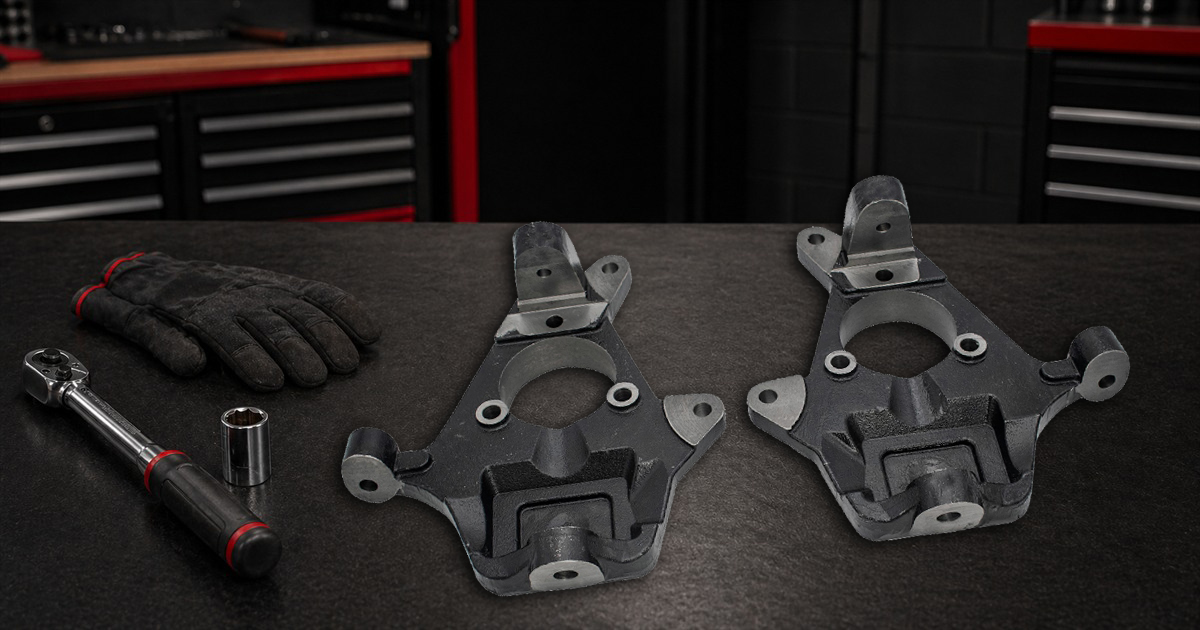
Before you grab a wrench, it helps to understand the mechanics of what you're installing. Your truck's spindle is the component that connects your wheel hub to your upper and lower ball joints. It's essentially the pivot point for the entire front-end assembly. The hub (where your wheel mounts) sits at a specific height relative to your suspension geometry, and that height determines how much clearance you have above your wheel.
A drop spindle changes the hub mounting position so the hub sits higher relative to the ball-joint locations, typically lowering the truck 1 to 3 inches depending on the design. This lets the truck body and frame sit lower over the same wheel while the suspension components stay closer to their original operating angles and ranges of motion. That is why drop spindles usually preserve ride quality and suspension travel better than cutting springs or using mismatched lowering parts. It is also why you can maintain the OEM length shocks and coils (or factory torsion keys if it is torsion bar suspension).
Think of it this way: your suspension was engineered to compress and extend through a specific range. A properly designed drop spindle lowers the truck by changing hub position instead of simply shortening the spring or forcing the suspension into a compressed position. That usually preserves more usable travel and gives a more predictable result than cutting springs or stacking mismatched parts.
Why Choose Drop Spindles Over Other Lowering Methods?
There's more than one way to lower a truck, and understanding why drop spindles are often the professional's choice matters. Cutting springs might be cheaper upfront, but you're compromising suspension geometry and ride quality. Cut coils reduce the amount of travel your suspension has, which means less wheel articulation and a harsher ride over bumps. Additionally, cutting the coil reduces the number of active coils the spring has which in turn will make it stiffer. You're also stuck with that decision-it's difficult to reverse.
Drop spindles, by contrast, are reversible on many bolt-on applications. If you ever decide to return your truck to stock height, you can usually unbolt the drop spindles and reinstall the original equipment, assuming the rest of the suspension has not been modified. Much of the suspension geometry stays close to the intended range because you're changing the vertical position of the hub rather than shortening the spring.
Ride quality is another significant advantage. Since you're not relying on spring preload or a much shorter spring to create the drop, the truck can ride close to stock when the spindle is designed correctly and the rest of the suspension is healthy. Drop spindles are generally a more predictable lowering method than cutting springs because they preserve more of the designed suspension travel.
Inspection rules vary by location. Drop spindles are often a cleaner lowering method because they do not require cutting the frame or changing spring rate, but you should still check local regulations before beginning any modification.
Tools You'll Need
Drop spindle installation is an intermediate-level DIY project. You are working around steering, brakes, bearings, and ball joints, so the right tools matter.
Some of the common items you will need are a hydraulic floor jack rated for your truck, quality jack stands, wheel chocks, a metric/SAE socket set, combination wrenches, a breaker bar, a torque wrench, penetrating oil, cotter pins, safety glasses, gloves, and a service manual or reliable torque reference for your exact truck.
You will also need a ball joint separator or tie rod separator. A pickle fork can work, but it may damage boots. A press-style separator is cleaner when you plan to reuse the joint. Use wire, a caliper hanger, or a bungee cord to support the brake caliper. Never let the caliper hang from the brake hose.
In most drop spindle installations, you should not disconnect the hydraulic brake hose from the caliper. If your specific install requires opening the brake system or replacing brake lines, use the correct line tools, new sealing washers where required, proper torque specs, and bleed the brakes before driving. Most standard drop spindles do not require this though.
Time Estimate and Skill Level
Most experienced mechanics or advanced DIYers complete both drop spindle installations in 2 to 4 hours. If you're working on your first set, add another hour or two. This isn't a quick job, but it's not an all-weekend project either. Breaking it down by side, expect around 1 to 2 hours per wheel once you have your system dialed in.
Skill level matters. This job is harder than changing brake pads but easier than, say, replacing control arms or rebuilding a full suspension. You need to be comfortable with a socket set, comfortable working with a torque wrench, and patient enough to follow a step-by-step process without rushing. Rushing suspension work is how mistakes happen. The most important skill is patience and an unwillingness to skip steps or torque specifications.
General Step-by-Step Drop Spindle Installation
Before you start, inspect the front end closely. A drop spindle installation is a good time to replace worn ball joints, tie rod ends, wheel bearings, brake hoses, rotors, pads, or other front-end parts that are already apart during the job. Reusing worn steering, brake, or bearing components can create noise, poor alignment, vibration, or unsafe handling even if the new spindles are installed correctly.
Step 1: Preparation and Safety
Park your truck on a flat, level surface away from traffic. A concrete driveway or garage floor is ideal. Turn off the engine and let it cool if you just drove it. Before you lift anything, break the lug nuts loose with the vehicle still on the ground. This is important because the wheel won't spin when the truck is on the ground, giving you real mechanical advantage. Loosen them with your socket wrench, but don't fully remove them yet.
Step 2: Raise and Support Your Truck
Position your floor jack under the frame rail close to the wheel you're working on, and raise the truck until the wheel is about 6 inches off the ground. Immediately place a jack stand under the frame and lower the truck onto the stand. Never work under a truck supported only by a jack. Once the truck is stable on jack stands, you can fully remove the lug nuts and set them aside in a container where you won't lose them.
Step 3: Remove the Wheel
Lift the wheel off the studs and set it aside. Keep it close by-you'll reinstall it at the end. With the wheel off, you now have clear access to your brake caliper, rotor, and the spindle assembly.
Step 4: Remove the Brake Caliper and Rotor
Unbolt the brake caliper and/or caliper bracket according to the truck’s brake design. Support the caliper with wire, a caliper hanger, or a bungee cord so there is no tension on the brake hose. Do not let the caliper hang by the hose.
Do not disconnect the hydraulic brake line unless the instructions specifically require it or you are replacing the hose. Opening the brake system adds extra work and requires proper bleeding before the truck is driven.
Remove the rotor according to the vehicle design. Some rotors slide off the hub after the caliper bracket is removed. Others may have retaining clips, a hub assembly, or a different setup. Set the brake parts aside in order and inspect pads, rotors, hoses, and bearings while everything is apart.
Step 5: Disconnect the Tie Rod End
Using your ball joint separator tool, disconnect the tie rod end from the spindle. The tie rod is what connects your steering system to the spindle. Position the separator tool as directed by the tool's instructions, and work it gently until the taper breaks. Once loose, unscrew the nut and remove the tie rod end completely from the spindle. Keep that nut-you may reuse it.
Step 6: Remove the Upper and Lower Ball Joints
This is where the spindle comes free from the suspension. Most trucks use tapered ball joint studs with castle nuts and cotter pins, but the exact layout varies by application.
Remove the cotter pins and loosen the castle nuts. Do not fully remove a nut until the taper has been broken loose; leaving the nut partly threaded can help control the release. Use the correct separator tool to break the taper. Avoid hammering directly on the ball joint stud because damaged threads can make reassembly unsafe.
Support the lower control arm as needed so the suspension does not drop unexpectedly. Once the upper and lower joints are separated and supported, make sure the spindle is controlled and ready to come off before fully removing the nuts.
Step 7: Remove the Stock Spindle
With all the connections free, the spindle should pull off easily. If it's stuck, a few light taps with a rubber mallet will usually persuade it. Don't force it. Once the spindle is off, set it aside. You've now exposed the hub assembly. Take a moment to inspect the ball joint studs, control arm condition, and the area around the hub. This is a good time to notice any wear or damage while everything is apart.
Step 8: Install Your Drop Spindle
Position the new drop spindle onto the upper and lower ball joint studs or mounting points according to the truck’s design. It should seat cleanly without forcing. If it does not line up, stop and verify the part number, orientation, and ball joint compatibility.
Install the castle nuts by hand first. Torque the ball joint and spindle fasteners to the vehicle service manual or manufacturer instructions for your exact application. Do not rely on generic torque numbers for ball joints, because specs vary by truck and fastener size.
After torqueing, install the cotter pins where required. If the cotter pin hole does not line up, follow the service manual procedure. Do not loosen a castle nut below spec just to make the pin fit.
On some AWD or 4WD applications, the upper ball joint stud may need to be trimmed after final torque to provide adequate clearance between the stud and the CV axle boot. Follow the spindle manufacturer's instructions for your application. Do not trim in a way that compromises nut engagement, cotter pin retention, or ball joint safety.
Step 9: Reinstall the Tie Rod End
Thread the tie rod end back into the spindle by hand first. The tie rod connects to your steering system, so this fastener matters. Torque it to the vehicle service manual or product-instruction specification for your exact truck rather than relying on a generic number. Once tight, align the cotter pin hole if one exists and install the cotter pin.
Step 10: Reinstall the Rotor
Reinstall the rotor or hub/rotor assembly according to the truck’s brake design. Make sure the rotor seats fully and rotates without rubbing once the caliper bracket is installed. If the truck uses hub bearings or retaining hardware, follow the service manual procedure.
Step 11: Reinstall the Brake Caliper
Reinstall the caliper bracket and caliper using the correct hardware and torque specs. Make sure the brake pads sit correctly and the rotor turns freely.
Check brake hose routing at full steering lock in both directions and through the expected suspension travel. The hose should not rub the spindle, wheel, tire, control arm, or spring. If the brake system was opened for any reason, bleed the brakes per the steps listed in the vehicle maintenance guide and confirm pedal feel before driving.
Step 12: Reinstall the Wheel
Lift the wheel onto the studs and thread the lug nuts on by hand. Assure the wheel can freely spin once placed on and that there is no contact with anything. Once all lugs are started, use your socket wrench to tighten them in a star pattern. This ensures even pressure. Tighten firmly but don't over-tighten. A typical truck wheel torque is around 100 to 120 foot-pounds, but check your service manual.
Step 13: Repeat on the Other Side
Lower your truck back onto the ground by releasing the jack stand and using your floor jack to lower it. Once stable, move to the other side and repeat steps 2 through 12. The second side often goes faster as you develop a rhythm with the process.
Step 14: Get a Professional Alignment
Once both drop spindles are installed and the truck is back on the ground, get a professional alignment. Drop spindles often preserve much of the original geometry, but toe can still change during installation and caster/camber should be verified.
Tell the alignment shop that drop spindles were installed and provide any product notes. After the first short drive, recheck for brake hose clearance, rubbing, noise, and loose hardware. Trekline recommends verifying the torque on all bolts / wheel lugs after 50 miles, 100 miles and 500 miles.
Tips and Common Mistakes to Avoid
The biggest mistake is letting the brake caliper hang by the brake hose. Always support the caliper. The next mistake is opening the brake system when you do not need to. If the hydraulic line is disconnected, the brakes must be bled correctly before driving.
Do not guess on torque specs. Spindle, ball joint, tie rod, caliper bracket, and wheel lug torque all matter. Use the vehicle service manual and the product instructions. U-bolt torque is a separate topic; see our U-bolt torque guide for rear suspension hardware on Trekline provided u-bolts.
Before final tightening, check brake hose routing, ABS wire routing, wheel clearance, and steering sweep. Turn the steering wheel fully left and right and confirm nothing rubs or pulls tight.
Use new cotter pins. If a fastener will not torque correctly, if threads are damaged, or if the spindle does not seat cleanly, stop and correct the issue before driving.
Do not skip the alignment. Even a clean spindle install should be checked so the truck does not wander, pull, or wear the tires unevenly.
Where Spindles Fit in the Bigger Lowering Picture
Drop spindles are powerful on their own, but most truck owners pair them with complementary upgrades to fine-tune stance and handling. Classic trucks like C10s and early C-series rigs often pair front spindles with rear drop shackles to produce a balanced, level stance. Drop shackles re-work the rear shackle geometry, and when paired with front drop spindles, they create a cohesive lowered look without cutting anything.
Modern trucks like Silverados benefit from flip kits, which relocate the rear axle above the leaf springs to drop the rear without cutting coils or collapsing travel. A flip kit paired with drop spindles gives you flexibility in how low you want to go. Some owners install drop spindles with stock springs and shocks; others pair them with lowered coil springs or airbags for more aggressive stance control.
Spindles are a lowering tool, but understanding the whole category saves you from buying the wrong part twice. And before you put any money down, use our full cost-to-lower-a-truck guide to build a realistic budget that covers spindles, shackles, shocks, alignment, and the labor if you're farming any of it out.
Don't Forget the Upper Control Arms (On Some Platforms)
Drop spindles alone often keep the upper control arm (UCA) operating closer to its intended range than a spring-only drop, which is one reason they are popular. That said, lowering UCAs can still matter on lowered trucks. On some platforms, aftermarket upper arms help correct camber after lowering and place the ball joint in a better operating angle, especially when spindles are combined with coils, control arms, adjustable struts, air ride, or a more aggressive front drop.
Trekline Motorsports Drop Spindle Options
At Trekline Motorsports, we've assembled drop spindle kits for virtually every truck platform. For classic 73-87 C10/C15 C1500 trucks, we offer two rotor-specific options: our 73-87 C10/C15 C1500 3" Drop Spindles with 1.25" rotors (SKU 8000100, $250) and our 73-87 C10/C15 C1500 3" Drop Spindles with 1.00" rotors (SKU 8000101, $250). Choose based on your brake system configuration. For the OBS generation, our 88-91 C1500 Standard Cab (1" rotors) 2" Drop Spindles (SKU 8000102, $269) cover early Std Cabs running the 1" rotor, and our 88-98 C1500 (1.25" rotors, excl. 88-91 Std Cab) 2" Drop Spindles (SKU 8000103, $269) cover the rest of the 88-98 C1500 2WD range (Ext Cabs and later 1.25"-rotor trucks). Each delivers a clean 2-inch front drop.
To complete your front suspension package, pair drop spindles with our 88-98 C1500/K1500 1" or 2" Rear Lowering Drop Shackles (SKU 8000400, $46) to balance your stance in the rear. If you're working with a 2007-2013 Silverado 1500, our 07-13 Silverado/Sierra 1500 5"-6" Rear Drop Axle Flip Kit + Lift Hanger (SKU 8000510, $205) pairs well with drop-spindle and lowering coil front ends for a balanced lowered stance. All kits are assembled in our Dunlap, Tennessee facility with over 20 years of suspension expertise behind them, and we ship within one business day of your order.
Have questions about which spindle is right for your truck? Reach out to our suspension experts at info@treklinemotorsports.com. We're here to help.
Frequently Asked Questions
Can I install drop spindles on any truck?
No. Drop spindles must be designed for the exact truck platform, drivetrain, brake setup, wheel size, and sometimes rotor thickness. Always verify fitment before ordering.
Will drop spindles affect my truck's handling?
When installed correctly and aligned, drop spindles can maintain good ride quality because they do not lower the truck by shortening the spring. The truck will still sit lower, so ground clearance and steering/wheel clearance need to be checked.
Do I need new shocks when installing drop spindles?
Often, stock-length shocks can still work with drop spindles because spindle drop does not usually change spring travel. If the shocks are worn, or if the drop is combined with coils or control arms, matched lowered shocks may be needed.
How much will my truck drop with drop spindles alone?
Most drop spindles lower the front about 2 to 3 inches depending on the application. Check the product listing for the exact drop amount.
Can I do this installation without a torque wrench?
No. A torque wrench is required. Steering, brake, and suspension fasteners must be tightened to the correct spec.
What if I can't get the tie rod end or ball joint to separate?
Use penetrating oil and the correct separator tool. Do not hammer directly on the threads. If the joint will not separate safely, get help from a shop.
Do I need an alignment after installing drop spindles?
Yes. Drop spindles may keep the suspension close to factory geometry, but the front end should still be aligned after installation.
How often do I need to service drop spindles?
Inspect them during normal suspension and brake service. Check ball joints, tie rods, bearings, brake hose routing, and fastener condition regularly.
Conclusion
Installing drop spindles is a satisfying project that transforms your truck's stance while preserving the integrity of your suspension system. Unlike more aggressive lowering methods, drop spindles offer reversibility, maintained suspension travel, and excellent ride quality. Follow the steps in this guide, respect torque specifications, and don't skip the alignment, and you'll have a professional-quality installation you can be proud of.
At Trekline Motorsports, we've been building suspension solutions for over 20 years. Our drop spindles are designed for trucks that deserve better, and we ship them within one business day so you can get to work. Whether you're lowering a classic C10 or a modern Silverado, we have the spindles and the expertise to guide you through the process. Questions? Reach out to us at info@treklinemotorsports.com. That's how we do business.