
Ford F-150 Leveling Kit Guide: What Fits and What to Watch For
Posted by Trekline Motorsports on May 6th 2026
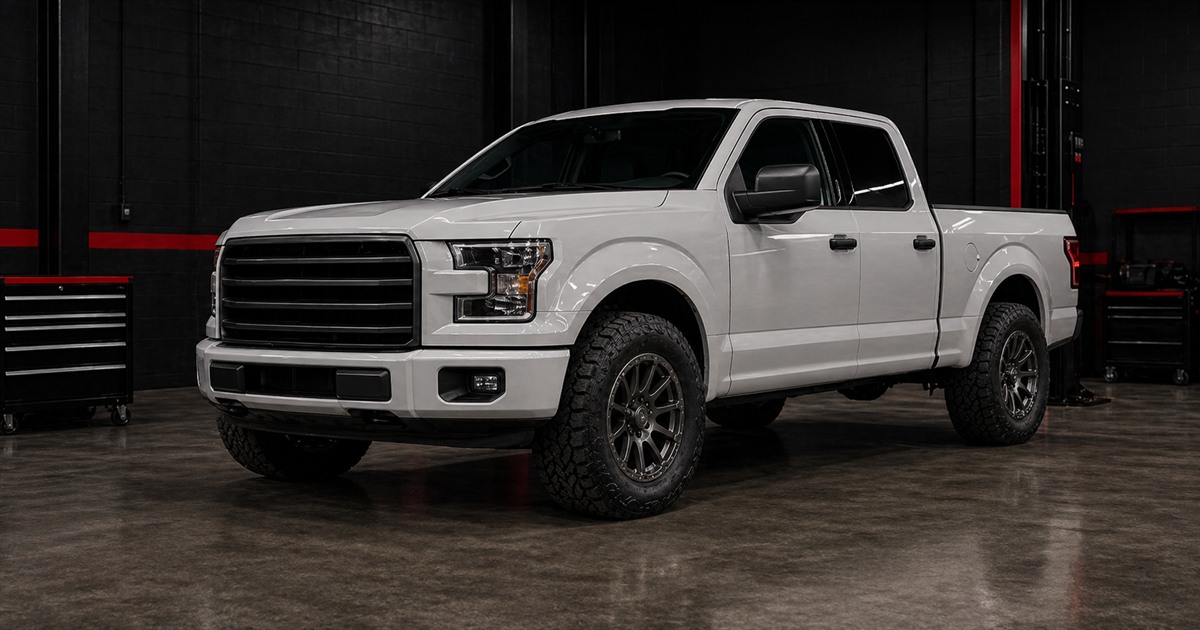
If you've owned a Ford F-150 for any amount of time, you've probably noticed that unique truck rake - that slight downward slope from the back to the front. It's there by design, helping with trailer tongue weight distribution and maintaining a professional appearance. But if you're sick of looking at that sloped stance or want to clear bigger tires up front, a leveling kit is one of the smartest first mods you can make.
As suspension specialists with over 20 years in the truck accessory business, we've installed leveling kits on thousands of F-150s. In this guide, we'll walk you through everything you need to know: which suspension systems your truck has, what leveling options exist, how much lift you can expect, tire fitment at different heights, the installation process, costs, and mistakes to avoid. Whether you're tackling this yourself or having a shop handle it, you'll have the knowledge to make the right call for your truck. If you're still deciding between a simple level and a full lift, start with our lift kit vs leveling kit comparison.
Understanding Your F-150's Suspension: Which Generation Do You Have?
Before choosing a leveling kit, identify the generation and front suspension layout. F-150 leveling parts are not interchangeable across every year range.
1997-2003 (10th Generation) F-150
These trucks can vary by drivetrain. Many 4WD models use torsion bars up front, while many 2WD models use coil-spring front suspension. A 4WD torsion-bar truck usually levels with torsion keys. A 2WD coil-spring truck needs a different style of front lift part such as leveling coils or coil spacers.
If you have a 2004 F-150, confirm whether it is the Heritage/old-body truck or the new 11th-generation body. That model-year split matters for suspension parts.
2004-2008 (11th Generation) F-150
The new-body 2004-2008 F-150 moved to a strut style independent front suspension. These trucks do not use the same front torsion-key leveling method as the older 4WD trucks. Leveling is commonly handled with strut spacers or other application-specific front suspension parts such as strut preload spacers.
2009-2014 (12th Generation) F-150
The 2009-2014 trucks continued with independent front suspension using strut-style front assemblies. These are common leveling-kit candidates because a mild front spacer can reduce the factory rake without a full suspension lift.
2015-2020 (13th Generation) F-150
The aluminum-body trucks are also commonly leveled with front strut spacer kits. Because these trucks are newer and often use larger factory wheels, verify brake line routing, tire clearance, wheel offset, and alignment range before choosing the tallest spacer available.
2021-Present (14th Generation) F-150
Newer F-150s continue to use front strut-style suspension, but fitment should be verified carefully by model year, engine/package, drivetrain, and trim. If a Trekline product lists coverage through a specific model year, do not assume it automatically fits newer trucks unless the product page confirms it.
Leveling Kit Methods: How Each One Works
Leveling kits raise the front of the truck to reduce the factory nose-down rake. The correct method depends on the suspension under your F-150.
Strut Spacers: The Modern Standard
On modern F-150s with strut-style front suspension, strut spacers are the most common leveling method. Most top-mount spacers sit above the strut assembly and raise the front by changing the mounted position of the assembly. They do not add suspension travel, and if pushed too far they can reduce droop travel or make alignment harder.
Trekline offers 04-23 F-150 2WD/4WD 3-inch front leveling lift strut spacers for listed applications. Verify the product page and your truck details before ordering, especially on newer model years and special trims. Also pay attention to product fitment notes: the 3-inch version is not recommended for some later 4WD applications, where a milder spacer may be the better choice.
Torsion Keys: The Older 4WD Leveling Solution
Older 4WD F-150 trucks that use torsion bars can be leveled with torsion keys. A torsion key re-indexes the adjustment point so the front ride height can be raised within a controlled range. It does not add suspension travel, and over-adjusting can reduce droop travel and increase wear.
Torsion keys are not for new-body 2004+ strut-style F-150 trucks. If your truck has front strut assemblies, use the correct strut spacer or suspension kit instead.
Coil Spacers and Lift Shackles: Alternative Options
Some 2WD or older coil-spring front setups may use coil spacers or lift coils, depending on the truck. Rear lift shackles can adjust the rear stance on leaf-spring trucks, but they are not a front leveling part. Match the part to the exact suspension layout.
How Much Lift Can You Actually Get?
Most F-150 leveling kits fall in the 1.5- to 3-inch lift range. The right amount depends on how much factory rake your truck has and how the truck will be used.
A mild 1.5- to 2-inch level is usually the safest choice for daily driving because it reduces rake without pushing the front suspension as far from factory geometry. A 2.5- to 3-inch level creates a taller stance, but it can make alignment, upper ball joint angle, droop travel, and tire clearance more important.
Measure your truck before ordering. Park on level ground and measure from the center of the wheel hub to the fender lip at all four corners. The difference between the front and rear measurements tells you how much rake the truck actually has.
Do You Need Upper Control Arms?
Upper control arms are not automatically required for every F-150 leveling kit, but they become more important as lift height increases.
On many IFS trucks, aftermarket upper control arms can help restore alignment range, improve ball joint angle, add tire clearance, and improve suspension movement near full droop. They do not add height by themselves, and they do not directly fix CV axle angle on 4WD trucks.
For mild leveling, stock upper control arms may be acceptable if the truck aligns correctly and the ball joint angle is reasonable. For taller leveling kits, aggressive wheel/tire setups, or trucks that see off-road use, upper control arms are worth considering. Our upper control arms after lift guide explains when they make sense.
Tire Fitment After Leveling: What Sizes Work at Each Height
Tire fitment depends on lift height, wheel width, offset, backspacing, tire width, bumper clearance, crash bar/fender liner clearance, and whether you are willing to trim. Use these as general guidelines only.
1.5-2 inches of level: Many owners can run a modest tire upgrade while keeping a clean daily-driver setup. Rubbing depends heavily on wheel offset and tire width.
2.5-3 inches of level: Larger tire setups become possible, but fitment is more sensitive. Wider tires and negative offset wheels may rub even when the height looks like it should clear.
Going beyond leveling: If the target is a much larger tire, a true suspension lift may be the better route than stacking parts or maxing out a leveling kit.
Always cycle the steering from lock to lock and check clearance at ride height and suspension compression before regular driving.
Installation Walkthrough: What to Expect
The installation process depends on the suspension type. This is a general overview, not a substitute for the product instructions or the Ford service manual.
For strut spacer kits, the front of the truck is lifted and supported, wheels are removed, and the strut assembly is unbolted. The spacer is installed in the correct position, then the assembly is reinstalled and all hardware is torqued to spec. Some trucks require separating suspension components to safely remove the strut assembly.
For torsion-key trucks, the torsion bar system must be unloaded with the correct torsion bar unloading tool. Do not try to remove torsion keys with a basic puller or unsafe workaround. Torsion bars store a large amount of energy.
After installation, the truck should be aligned and the hardware should be rechecked after the initial drive period.
Cost Breakdown: Parts, Labor, and Alignment
Let's talk money. A complete leveling kit installation involves three main costs: the kit itself, labor if you have a shop do it, and wheel alignment. For a full tier-by-tier breakdown across lift heights, see our how much does it cost to lift a truck guide.
The parts cost varies by method and truck generation. Our 04-23 F-150 3" front strut spacer (SKU 8001010) and 04-23 F-150 2" front strut spacer (SKU 8001026) each run about $66 for the front pair, but always check the fitment notes before choosing the taller 3-inch version. Our 97-03 F-150 / 98-02 Expedition 4WD Leveling Torsion Keys (SKU 8000907) are $66 for the pair. Lift spindles are more expensive at $348 for the 97-03 F-150 2WD 3.5" Lift Spindles (SKU 8000213) because they're a more complex component. Our 04-14 F-150 1" Rear Lift Shackles (SKU 8000310) are $62 for the pair. These prices are competitive because Trekline has been in this business for over 20 years and assembles kits efficiently from quality materials.
If you're handy and do the installation yourself, you're looking at just the parts cost plus maybe some consumables like new bolts, washers, or gaskets. You'll still need a professional alignment afterward, which typically runs $100 to $200 depending on your location and whether you need additional suspension work.
If you have a shop install your leveling kit, expect to pay $200 to $400 in labor depending on the method. Strut spacers are on the lower end because they're straightforward. Torsion key adjustment might run higher because it requires more time and precision. Add in the alignment cost, and a complete professional installation runs $400 to $700 from start to finish. For many people, this is reasonable compared to the value of having the work done right.
Trekline ships many in-stock orders within one business day, so you can get your kit and get it installed quickly. Contact us at info@treklinemotorsports.com if you have questions about fitment for your specific truck or if you need installation advice.
Common Leveling Kit Mistakes to Avoid
Ordering by year only. F-150 suspension changed across generations, and 2004 is especially important because of old-body (heritage) /new-body differences. Verify suspension type, drivetrain, and product fitment.
Assuming all 2004+ trucks use torsion keys. New-body 2004+ F-150 trucks use strut-style front suspension, not the old torsion-key leveling method.
Choosing the tallest kit without checking geometry. A taller level may look better, but it can reduce droop travel, make alignment harder, and create more ball joint angle.
Skipping the alignment. Any front leveling work should be followed by an alignment. This helps prevent pulling, wandering, and uneven tire wear.
Ignoring tire and wheel offset. Tire size alone does not determine fitment. Offset and tire width often decide whether the truck rubs.
Frequently Asked Questions About F-150 Leveling Kits
Will a leveling kit affect my ride quality?
A mild, properly installed leveling kit usually keeps ride quality close to stock. Taller setups can reduce droop travel or make the front suspension feel firmer, especially if the kit is maxed out.
Can I install a leveling kit myself, or do I need a shop?
Experienced DIYers may be able to install some strut spacer kits with the right tools. Torsion-key trucks require a proper torsion bar unloading tool. Professional installation is recommended if you are not comfortable working with suspension parts under load.
How long does a leveling kit last?
A quality leveling kit can last for years when installed correctly. Inspect the front end regularly and watch for uneven tire wear, noise, loose hardware, or alignment changes.
Will a leveling kit void my warranty?
A leveling kit does not automatically void an entire warranty, but a warranty claim may be questioned if the leveling kit caused the failure. Read our lift kit warranty guide for more detail.
Can I combine a leveling kit with a rear lift?
Yes, but plan the stance as a complete system. Rear shackles, blocks, or other parts can adjust rear height, but the final setup should keep alignment, shock length, brake hose routing, and tire clearance in check.
What's the difference between a leveling kit and a full lift kit?
A leveling kit usually raises the front to reduce factory rake. A full lift kit raises the front and rear and often includes more parts to manage geometry. Our lift kit vs leveling kit guide explains the difference.
Do I need new wheels and tires for a leveling kit?
No, but many owners use a leveling kit to make room for a larger tire. Verify tire clearance before buying wheels and tires, especially with wider tires or lower-offset wheels.
How do I know if a leveling kit is right for my truck?
Measure your current front and rear ride height, decide your tire goal, and confirm your front suspension type. A mild level is a good fit for many daily-driven trucks. A true suspension lift is better if you want a much taller stance or significantly larger tires.
Getting Started With Your F-150 Leveling Kit
A leveling kit is one of the most practical suspension upgrades you can make to an F-150. It's relatively affordable, the installation is straightforward enough for an experienced DIYer or a competent shop, and the results are immediately visible. Whether you want to achieve that level stance, fit bigger tires, or just improve your truck's overall appearance, there's a leveling kit option for your generation of F-150.
At Trekline Motorsports, we've been assembling quality suspension kits for over 20 years right here in Dunlap, Tennessee. We know F-150s inside and out, and we stand behind every kit we ship. Many in-stock orders ship within one business day, so you can have your leveling kit and get it installed quickly. If you have any questions about fitment, suspension geometry, or which kit is right for your truck, reach out to us at info@treklinemotorsports.com. We're here to help you get your F-150 sitting exactly how you want it.