
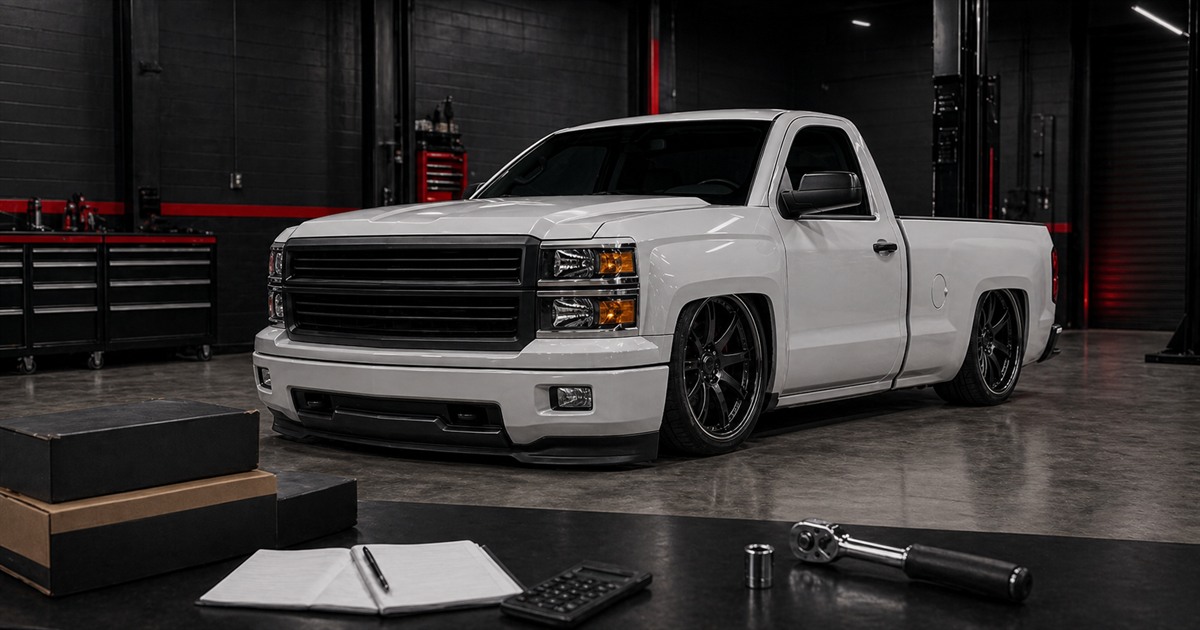
How Much Does It Cost to Lower a Truck?
Posted by Trekline Motorsports on May 6th 2026
Lowering a Truck: What It Actually Costs in 2026
A slammed truck looks incredible, but you don't have to spend thousands to get a lower stance. Whether you want a subtle 2-inch drop for better handling or a head-turning 5/7 show truck, the cost of lowering a truck varies wildly depending on what you're going for and how you get there.
After 20-plus years working with aftermarket suspension, We've helped guys build everything from mild street drops to frame-dragging show trucks. Here's an honest breakdown of what lowering a truck costs in 2026 - parts, labor, and the extras you need to plan for. For a full walkthrough of methods, components, and build recipes, pair this cost guide with our complete truck lowering guide.
How Lowering Kits Work (Quick Overview)
Before we talk prices, it helps to understand how trucks are lowered, because the method directly affects the cost. There are four main approaches, and most builds use a combination of them.
The front of a truck is typically lowered with drop spindles, lowering coils, or drop control arms - sometimes two of those together. Drop spindles relocate the hub mounting point higher relative to the ball joints, lowering the truck 2 to 3 inches while keeping suspension travel close to stock. Drop coils are shorter springs that bring the front end down 1 to 3 inches. Drop control arms are application-specific parts that can change spring-pocket, ball-joint, or arm-position relationships to help create more front drop, correct camber after lowering, and place the ball joint in a better operating angle when the truck needs it.
The rear is lowered with drop shackles (1 to 2 inches), shackles and hangers (3"-4") flip kits (5 to 6 inches by relocating the axle above the leaf springs instead of below), lowering blocks, or re-arched leaf springs. Most builds combine a front and rear method - for example, 3-inch drop spindles up front with a 5-inch flip kit in the rear is one of the most common street truck setups.
Lowering Kit Costs by Type (Parts Only)
Drop Shackles: $46 – $100
Drop shackles are one of the simplest and least expensive ways to lower the rear of a leaf-spring truck. A lowering shackle is usually longer and/or shaped differently than stock, which lets the frame sit lower relative to the spring and axle. Most drop shackles lower the rear about 1 to 2 inches.
This is a good first step if you want to reduce factory rake or bring the rear down slightly while keeping the rest of the truck simple.
Drop Coils: $150 – $300
Lowering coils replace the factory coil springs with shorter springs designed to bring the front down 1 to 3 inches depending on the truck and spring. Trekline’s 88-98 Chevy/GMC C1500 V8 2WD 2-inch front drop coils are one common example.
A drop coil can reduce available compression travel and may ride firmer depending on spring rate, shock choice, and how low the truck sits. It does not always reduce travel by the exact amount of the advertised drop, but it does make bump stop and shock selection more important.
Drop Spindles: $250 – $500
Drop spindles are a preferred front lowering method on many 2WD trucks because they lower the truck by relocating the hub position while keeping the spring and shock closer to their original operating range. Trekline offers options like 73-87 C10/C15/C1500 3-inch drop spindles and Chevrolet/GMC lowering spindle and drop kit options depending on the application.
Drop spindles are usually limited to a set amount of drop. If you want more, they may be combined with coils, control arms, or other parts. Our drop spindle installation guide explains the general installation sequence.
Flip Kits: $50 – $150
A flip kit is a common way to get a major rear drop on a leaf-spring truck. It relocates the axle from below the leaf springs to above the leaf springs, which typically lowers the rear about 5 to 7 inches depending on the truck and kit design.
Flip kit contents vary. Some include axle saddles, plates, U-bolts, shock relocation brackets, bump stop parts, hangers, or other hardware. Do not assume every flip kit includes the same parts. Deep rear drops often require or strongly benefit from a C-notch for axle-to-frame clearance.
Drop Control Arms: $340 – $850
Drop control arms change front suspension geometry to create or support more drop while helping alignment range and ball-joint angle when they are designed for the truck. They are more expensive than coils or spindles, but they can be the right choice for lowered builds that need camber correction, better ball-joint position, or a more complete front suspension setup.
C-Notch Kits: $90 – $200
A C-notch creates additional frame clearance above the rear axle. It is often required or strongly recommended when the rear is lowered more than about 4 to 5 inches, especially with flip kits. The exact need depends on the truck, bump stop height, tire size, load, and suspension travel.
Complete Lowering Kit Prices
Most complete builds combine front and rear parts. These price ranges are general starting points and can change with shocks, C-notch parts, brake line parts, and installation labor.
2/2 Drop (2-inch front, 2-inch rear): $175 – $360
A mild 2/2 drop is usually a daily-driver friendly setup. Common combinations include front drop spindles or coils with rear shackles or other mild rear parts. Ride quality can stay close to stock when shocks and bump stops are matched correctly.
3/5 Drop (3-inch front, 5-inch rear): $180 – $550
A 3/5 drop is a popular street-truck setup. It often pairs front drop spindles or coils with a rear flip kit. Some trucks can run this without a C-notch, while others need or strongly benefit from one. Always check frame-to-axle clearance, bump stop clearance, and shock travel before calling the job finished.
3/6 and 4/6 Drop: $240 – $900
At this level, the build is more involved. Rear C-notch clearance is commonly needed, and front alignment range, shock length, brake hose routing, and tire clearance all need to be checked. Matched shocks and quality bump stops become more important.
5/7 and Beyond: $800 – $3,000+
Extreme static drops and air-ride builds can require drop control arms, custom springs, flip kits, C-notches, shock relocation, frame clearance work, exhaust changes, and careful brake line routing. Plan these builds as a full system, not a collection of low-cost parts.
Air Ride Suspension: $1,500 – $5,000+
Air ride is in its own category. Instead of springs, you're running air bags controlled by a compressor, tank, and management system. The truck can go from stock height to fully slammed at the push of a button, which makes it the most versatile option - and the most expensive.
A basic front-only or rear-only air bag kit starts around $500 to $800. A complete four-corner air ride system with a compressor, tank, management ECU, and all the bags runs $1,500 to $3,500 for the kit. High-end digital management systems with Bluetooth control push that to $3,500 to $5,000+. Installation is complex and typically adds $800 to $2,000 in shop labor.
Air ride makes the most sense if you want to go low for shows but still need to clear speed bumps and driveways at normal ride height.
Labor Costs: DIY vs. Professional Installation
DIY Installation
Lowering kits are generally more involved than lift kits because you're working with tighter clearances and often dealing with the frame (C-notches). Here's a realistic time estimate for a DIYer with decent tools and experience.
Drop shackles alone take about 1 to 2 hours. A basic 2/2 drop kit with coils and shackles takes 3 to 5 hours. A 3/5 spindle and flip kit takes 5 to 8 hours. A full 4/6 or bigger build with C-notch takes 8 to 14 hours - usually a full weekend. Air ride is 10 to 20+ hours depending on how clean you want the install.
You'll need a floor jack, jack stands, a full socket set, a torque wrench, and a spring compressor for coil swaps. Flip kits and C-notch work also require a welder if the C-notch is a weld-in style (bolt-in kits exist but are less common).
Professional Shop Installation
Most shops charge $80 to $150 per hour for suspension work. Typical labor costs for lowering jobs break down like this.
A 2/2 drop with coils and shackles runs $300 to $600 in labor. A 3/5 spindle and flip kit is $500 to $1,000. A full 4/6+ build with C-notch is $1,000 to $2,000. A complete air ride system install typically costs $800 to $2,000 in labor alone, more if you want the lines and wiring hidden and clean.
Make sure your shop has experience with lowered trucks specifically. A general mechanic can swap springs, but flip kits, C-notches, and air ride installs need someone who knows what they're doing. Bad C-notch work is a frame integrity issue.
Additional Costs to Budget For
Alignment: $80 – $150
Front-end lowering work should be followed by an alignment. Some lowered trucks need extra parts or a specialty alignment shop if the factory adjustment range is not enough. Rear-only shackle or flip-kit work may not require a front alignment, but the truck should still be checked for tracking and vibration.
Lowered Shocks: $55 – $300
Stock shocks may work with some mild drops, especially certain drop spindle setups, but many lowered trucks need shorter shocks or relocated shocks to maintain travel. Follow the kit instructions and check compression and droop travel before driving.
Wheels and Tires: $800 – $3,000+
A lowered truck can run stock wheels if they clear the suspension and brakes, but many owners choose larger-diameter wheels and lower-profile tires for appearance. Make sure the wheel offset and tire size clear the fenders, control arms, and frame at full steering lock and compression.
Bump Stops: $20 – $30
Bump stops prevent metal-to-metal contact. Lowered trucks often need shorter or relocated bump stops. Do not remove bump stops without a plan for suspension travel and frame clearance.
Exhaust Modifications: $100 – $500
Lowering can create new exhaust clearance issues around the axle, frame, driveshaft, and pavement. Some builds need hanger changes, minor rerouting, or custom exhaust work.
Total Cost Breakdown by Build Level
Mild Drop (2/2): The Daily Driver
Parts run $175 to $360. DIY install is free, or a shop charges $300 to $600. Add the alignment at $80 to $150. Total: $255 to $1,110 with shop labor, or $255 to $510 DIY. This is the most practical build - better looks and handling without sacrificing daily drivability.
Street Truck (3/5): The Sweet Spot
The kit runs $180 to $550. Add matched shocks at $55 to $150. A shop install is $500 to $1,000 plus the alignment at $80 to $150. Total: $815 to $1,850 with professional installation, or $315 to $850 doing it yourself. This is the most popular build level because the truck looks significantly lowered without needing major frame work.
Show Build (4/6+): Making a Statement
The kit costs $400 to $1,000, plus a C-notch at $90 to $200, shocks at $100 to $300, and possibly control arms at $340 to $850. Professional installation runs $1,000 to $2,000 plus alignment. Total: $2,010 to $4,500 with shop labor. Add wheels and tires ($1,400 to $3,000) and you're looking at $3,400 to $7,500 for the full package.
Air Ride Build: Maximum Versatility
The air ride kit alone is $1,500 to $5,000+. Installation runs $800 to $2,000. Add alignment, possible frame notching, and misc hardware and you're at $2,800 to $8,000+ before wheels and tires. This is the premium option but gives you the most flexibility.
Lowering vs. Lifting: A Quick Cost Comparison
If you are still deciding whether to go up or down, the cost picture depends on the build level. A mild drop can be inexpensive, and a mild level can also be inexpensive. Mid-range lowering and lifting builds often land in a similar parts-and-labor range.
The biggest difference is often in the add-ons. Lifted trucks usually add cost through larger tires, wheels, gearing, and 4WD geometry correction. Lowered trucks often add cost through shocks, C-notches, brake line routing, exhaust clearance, and wheel/tire appearance upgrades. For the up-side of the equation, see our lift kit vs leveling kit comparison and our truck lift cost guide.
How to Save Money on a Lowering Build
The same principles from lifting apply here. DIY saves you $300 to $2,000 in labor. Buying direct from a supplier like Trekline cuts out unnecessary markup. And starting with a mild drop lets you upgrade in stages rather than committing to a full build all at once.
One lowering-specific tip: buy a complete kit instead of piecing together individual components. A front and rear kit that's designed to work together is almost always cheaper than buying drop coils, shackles, flip kits, and shocks separately. Plus you know the parts are matched for the right drop ratio front to rear.
Also, do not neglect axle-to-frame clearance on deeper rear drops. Around 4 to 5 inches of rear drop, and especially with many flip-kit setups, a C-notch may be required or strongly recommended. Skipping needed clearance can cause harsh bottoming, damaged bump stops, frame contact, poor ride quality, or unsafe suspension travel. That repair costs a lot more than the notch kit.
More questions about ordering, fitment, or returns - Check our site-wide FAQ page.
Frequently Asked Questions
How much does it cost to lower a truck 2 inches?
A mild 2-inch drop can start in the low hundreds for parts. With shop labor and alignment, the final price commonly lands several hundred dollars higher. The exact cost depends on whether the truck uses spindles, coils, shackles, hangers, or another platform-specific setup.
How much does a 3/5 drop cost?
A 3/5 drop usually costs more than a mild drop because it often includes front lowering parts, a rear flip kit, shocks, and possible C-notch or brake line work. Shop labor and alignment can make the total significantly higher than the parts price alone.
Is lowering a truck bad for it?
Not if it is done correctly. Problems usually come from cut springs, mismatched shocks, poor alignment, missing bump stops, no C-notch when needed, or brake line clearance issues.
Does lowering a truck improve handling?
A mild drop can lower the center of gravity and reduce body roll. Extremely low trucks with limited suspension travel can handle worse on rough roads because the suspension bottoms out more easily.
Do I need a C-notch to lower my truck?
It depends on the rear drop amount and the truck. Many deep rear drops and flip-kit setups require or strongly benefit from a C-notch to prevent axle-to-frame contact. Always check actual clearance.
What's cheaper, lowering or lifting a truck?
Neither is always cheaper. Mild versions of both can be affordable. Taller lifts and deeper drops both add cost because supporting parts, labor, alignment, shocks, and wheel/tire choices become more important.
Can I lower my 4WD truck?
Some 4WD trucks can be lowered mildly, especially torsion-bar trucks with the correct lowering keys, but most major lowering kits are designed for 2WD trucks. The front differential, CV axles, and transfer case/driveline layout limit how far many 4WD trucks can be lowered safely.
Does lowering a truck void the warranty?
Lowering does not automatically void an entire warranty, but warranty claims related to modified parts can be questioned if the lowering caused the problem. Keep receipts, installation records, and alignment paperwork. See our warranty guide for more detail.