
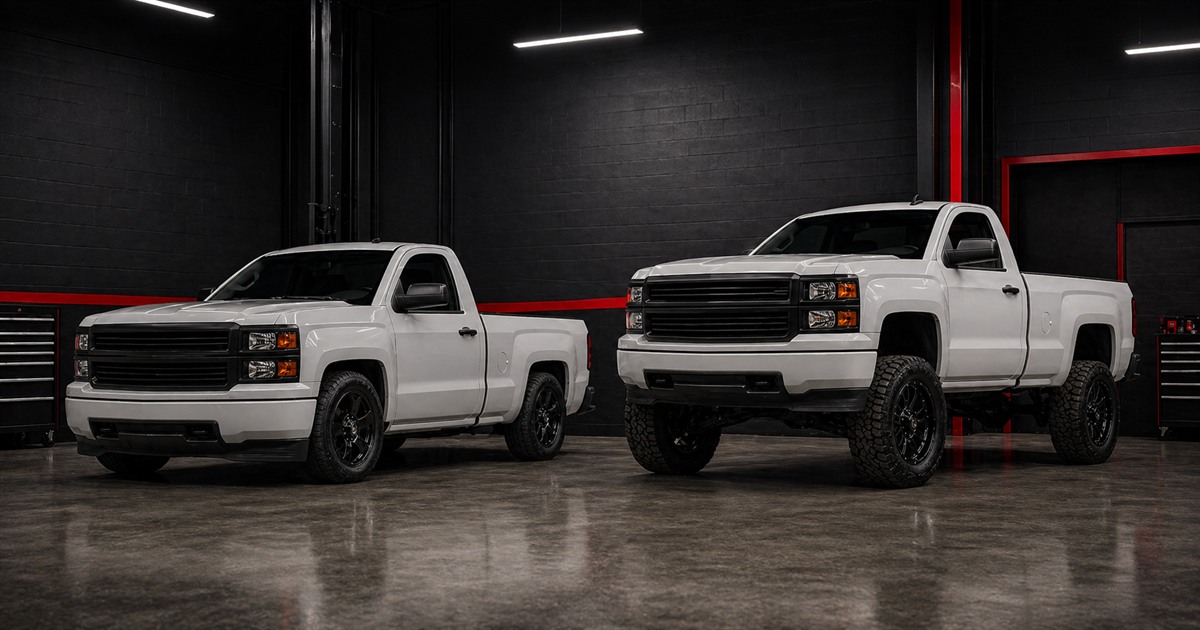
Lift Kit vs Leveling Kit: What’s the Difference?
Posted by Trekline Motorsports on May 6th 2026
They Both Raise Your Truck - But That's Where the Similarity Ends
If you're new to the aftermarket suspension world, the terms "lift kit" and "leveling kit" probably sound interchangeable. They both make your truck taller, right? Technically, yes. But the way they do it, what they cost, and what they're designed for are completely different. Choosing the wrong one wastes money and might not even give you the result you wanted.
Here's a no-nonsense comparison from 20-plus years in the suspension industry. By the end of this, you'll know exactly which one makes sense for your truck and your goals.
What Is a Leveling Kit?
A leveling kit raises the front of your truck to reduce the factory nose-down rake. Most trucks sit slightly lower in the front from the factory so they sit closer to level when the bed is loaded or a trailer is attached.
If you do not tow or haul heavy loads often, that nose-down stance may not be the look you want. A leveling kit usually raises the front about 1 to 3 inches so the truck sits more level front-to-rear.
Leveling parts depend on the front suspension design:
Strut spacers are common on newer trucks with strut-style front suspension. They usually mount above the strut assembly and raise the truck by changing the assembly’s mounted position.
Torsion keys are used on torsion-bar trucks such as many GM 4WD models. A torsion key re-indexes the torsion bar adjuster to create more height adjustment range. Torsion bars are under load, so use the proper unloading tool.
Coil spring spacers are used on some coil-spring trucks. They add height at the coil spring location and should be kept within the recommended range for the truck.
In most cases, a leveling kit changes the front only. The rear stays stock unless you also add rear blocks, shackles, or another rear-height part. If you drive an F-150, read our Ford F-150 leveling kit guide before ordering because suspension layout changes by generation.
One caveat is what happens if you lower the rear to be level with the front instead - Adding a set of rear lowering shackles or lowering coils on a truck / SUV can usually drop the rear end down level with the front. So in this regard, the lowering shackles or coils would act as a leveling kit.
What Is a Lift Kit?
A lift kit raises the truck more than a basic level and usually includes parts for both the front and rear. Lift kits may be mild 2- to 3-inch systems or larger suspension systems that raise the truck 4, 6, or more inches.
Depending on the truck and height, a lift kit can include lift spindles, strut spacers, coil spacers, lift coils, lift blocks, lift shackles, shocks, brake line brackets, upper control arms, lift knuckles, drop brackets, differential drop parts, and U-bolts.
A lift kit can improve body, frame, and bumper clearance, and it can make room for larger tires. Axle and differential ground clearance usually comes from the larger tire diameter, not the lift kit itself.
For example, a 2WD Silverado/Sierra may use front lift spindles with rear lift blocks for a clean street-style lift. A 4WD IFS truck usually needs more geometry correction because of CV axles and the front differential. Silverado owners can see our Silverado lift kit buyer's guide for generation-specific notes.
Leveling Kit vs Lift Kit: Side-by-Side Comparison
Height
A leveling kit usually raises the front 1 to 3 inches to reduce factory rake. A lift kit raises the truck overall and can range from mild to very tall depending on the kit.
Cost
Leveling kits are usually cheaper because they use fewer parts. Lift kits cost more because they raise more of the truck and may require shocks, brake line parts, steering correction, CV-angle correction, or rear suspension hardware. For detailed pricing, see our truck lift cost guide. Drivetrain also affects price; our 2WD vs 4WD lift guide explains why.
Installation Difficulty
Some leveling kits are simple bolt-on jobs, but not all are beginner-friendly. Torsion-bar trucks require the proper unloading tool, and strut work requires safe support and correct torque procedures. Larger lift kits should be installed by experienced shops.
Ride Quality
A mild leveling kit may keep the ride close to stock. A taller level can reduce droop travel or make the front feel firmer. Lift kit ride quality depends on the design. Spindle lifts can preserve ride quality on many 2WD trucks, while spacer-only setups or poorly matched shocks can ride worse than the factory ride.
Tire Size
A leveling kit may allow a modest tire upgrade. A lift kit usually allows larger tires, but tire fitment still depends on wheel width, offset, backspacing, tire width, trimming, bumper clearance, and control arm clearance. Do not assume a tire will fit based only on lift height.
Off-Road Performance
A leveling kit can improve front clearance slightly, but it does not add suspension travel. A well-designed lift kit can improve approach angle and make room for larger tires. True axle/differential clearance increases mainly when tire diameter increases.
Towing and Hauling
Factory rake helps a truck sit level when loaded. A front leveling kit removes some of that rake, so the truck may sit nose-high when towing or hauling. Lift kits also do not increase the factory tow or payload rating. Helper springs, air assist, or upgraded rear springs may help stance under load, but they do not change the manufacturer’s rating.
Warranty Impact
Neither a leveling kit nor a lift kit automatically voids an entire warranty. Claims related to modified parts can still be questioned if the modification caused the failure. Keep receipts and alignment records, and read our warranty guide.
Don't Forget the Supporting Components
Whichever route you choose, the supporting parts matter. Depending on the truck and lift height, you may need shocks, shock extenders, brake line brackets, extended brake lines, U-bolts, differential drop parts, or aftermarket upper control arms.
Upper control arms are not required for every lift or level, but they are commonly used on taller IFS setups to improve ball joint angle, tire clearance, and alignment range. Our upper control arms after lift guide explains when they make sense.
When a Leveling Kit Makes More Sense
A leveling kit is the right call if you want to reduce factory rake for a better stance, fit a modest tire upgrade where clearance allows, keep the budget under control, and avoid the complexity of a full suspension lift. It can also be the better choice if you're leasing the truck or plan to sell it soon, since many leveling setups are easier to reverse than larger suspension systems.
When a Lift Kit Makes More Sense
Go with a lift kit if you want to run larger tires, need more frame/body clearance and approach angle, want the truck noticeably taller from every angle, are building a dedicated trail rig or overlander, or plan to keep the truck long-term and want to invest in the build. Lift kits are a bigger investment but they deliver a bigger transformation. True axle and differential clearance still comes mainly from tire diameter.
Can You Stack Both?
You may be able to combine a mild front leveling part with rear blocks or shackles to create a small budget lift. That can work when the parts are compatible and the final height stays within a safe range.
Do not stack multiple spacers or push a leveling kit beyond its intended use to chase a taller lift. Spacer stacking can reduce travel, create poor geometry, and make the truck harder to align. For anything beyond a mild lift, use a purpose-built kit designed for the truck.
The Bottom Line
If you just want your truck to sit more level and look better in the driveway, a mild leveling kit may be the right tool. It is affordable and effective when used within its intended range. If you want to go higher, run significantly larger tires, or build around off-road clearance, invest in a proper lift kit. They're different tools for different jobs, and knowing which one you need saves you from spending money on the wrong thing.
Still have questions? Check our site-wide FAQ page for quick answers on ordering, fitment, returns, and installation.
Frequently Asked Questions
Is a leveling kit the same as a lift kit?
No. A leveling kit usually raises the front to reduce factory rake. A lift kit raises the truck overall and usually includes front and rear components.
Can I put a leveling kit on a 4WD truck?
Yes, if the kit is designed for that exact 4WD truck. 4WD IFS trucks need extra attention to CV angles, shock length, and alignment range.
Will a leveling kit void my warranty?
A leveling kit does not automatically void an entire warranty, but a claim may be questioned if the leveling kit caused the failure. Keep receipts and alignment records.
How long does it take to install a leveling kit vs a lift kit?
A simple leveling kit may take a few hours. A full lift kit can take much longer depending on the truck and parts involved. Larger kits should be installed by an experienced shop.
Do I need an alignment after a leveling kit?
Yes. Any front ride-height change should be followed by an alignment.
What size tires can I fit with a leveling kit?
Usually a modest tire upgrade, but it depends on the truck, wheel offset, tire width, and trimming. A leveling kit does not guarantee a specific tire size.
Is a 2-inch leveling kit worth it?
For many truck owners, yes. It is one of the most affordable ways to improve stance and make room for a mild tire upgrade, as long as the truck aligns properly afterward.
Can I go from a leveling kit to a lift kit later?
Yes. In most cases, the leveling parts can be removed and replaced with a proper lift kit. Do not assume the leveling parts should be stacked with the new lift.