
Grade 8 U-Bolt Torque Specs (Plated) | Suspension Torque Guide
Posted by Trekline Motorsports on May 6th 2026
By the Trekline Motorsports Suspension Experts · Updated April 2026 · ~3,300 words, 15–18 min read
A practical reference for properly torquing Grade 8 plated U-bolts on common truck suspension setups.
Introduction: Why U-Bolt Torque Matters
If you have ever heard a clunking sound from under your truck or noticed the axle shifting under acceleration or braking, U-bolt torque should be one of the first things checked. U-bolts clamp the axle, spring pack, spring pad, and related hardware together. That clamping force is what keeps the rear suspension located correctly.
This guide gives general Grade 8 zinc-plated U-bolt torque guidance and explains how to install and re-torque them. It is not a replacement for the instructions that came with a specific kit. If your Trekline kit, vehicle service manual, or product instructions list a different torque value, use that information first.
For the bigger picture on lowered suspensions where U-bolts are especially important, pair this reference with our complete truck lowering guide.
One quick note about the U-bolts Trekline supplies: they are high-strength Grade 8 fasteners with a zinc-plated finish. The chart below is intended for clean Grade 8 zinc-plated U-bolts using standard hardened washers and correct nuts on clean, undamaged threads.
What U-Bolts Do: The Foundation of Your Suspension
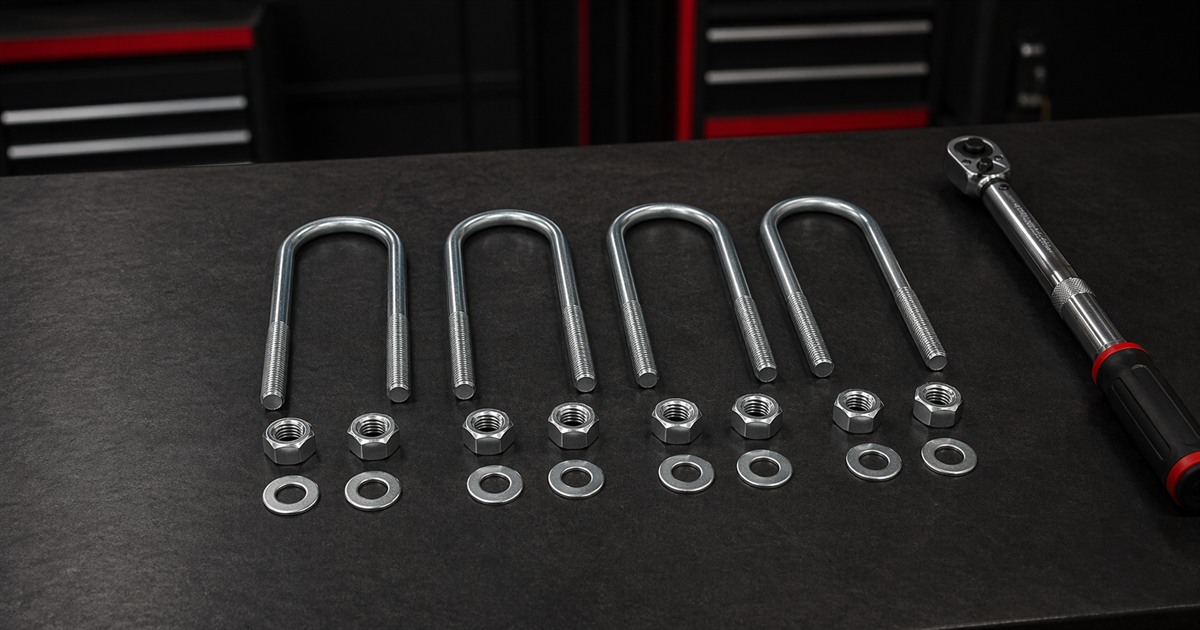
A U-bolt is a fastener shaped like the letter "U" that wraps around the axle tube or suspension bracket, passes through the spring plate or related hardware, and is secured with nuts and washers. The U-bolt's job is straightforward but absolutely critical: it clamps the axle and spring hardware firmly together so the components move as a unified system.
Without proper U-bolt clamping force, your axle can shift relative to your springs during acceleration, braking, and cornering. This creates several problems. The axle can literally rotate around the spring - a phenomenon known as axle wrap - which destroys handling and can damage other suspension components. The leaf springs can separate from the axle pad, creating a gap that allows the suspension to bind up and fail under load. And the repetitive micro-movement between the axle and spring causes wear, noise, and eventual component failure.
This is why U-bolt torque is not a "best guess" situation. The torque specification tells you exactly how tight to make the connection so the clamping force is just right: strong enough to eliminate any movement between axle and spring, but not so tight that you stretch or break the U-bolt itself.
Why Proper Torque Specs Matter: Too Loose vs. Too Tight
Understanding the consequences of improper torque will help you take U-bolt installation seriously.
When U-bolts are torqued too loose, the clamping force isn't sufficient to prevent the axle from shifting under load. You'll notice clunking sounds as the axle bounces against the spring pad. The suspension feels unstable, especially during hard cornering or acceleration. Over time, the loose connection creates wear marks on both the axle and the spring pad, damage that becomes permanent. The leaf springs themselves can separate from the axle pad or develop cracks where stress concentrates. In extreme cases, a severely loose U-bolt can allow the axle to shift enough to damage brake lines, fuel lines, or suspension components.
When U-bolts are torqued too tight, you're applying more clamping force than the U-bolt is designed to handle. The bolt stretches under the excessive load, losing some of its clamping ability even before you're done tightening it. The threads can strip if you continue tightening. The bolt itself can crack or break, especially if you use an impact wrench instead of a torque wrench. And in some cases, over-torquing the U-bolts can actually warp the axle or spring, creating a permanent deformation that ruins the suspension geometry.
The torque specification is the Goldilocks zone: just right. It provides enough clamping force to hold the axle and spring together while keeping the U-bolt within its design limits. That's why we take these numbers seriously.
General U-Bolt Torque Specifications by Diameter (Grade 8, Zinc-Plated)
These torque values are Trekline’s general reference chart for Grade 8 zinc-plated U-bolts. Torque is driven primarily by bolt diameter and thread pitch. Larger diameter U-bolts can carry more clamping force because they have more cross-section and thread engagement area.
If your suspension kit came with its own torque sheet, that sheet takes priority. U-bolt grade, diameter, thread pitch, washer type, nut type, and lubrication all affect torque.
| U-Bolt Diameter | Thread Pitch (TPI) | Torque Range (ft-lbs) | Typical Application |
|---|---|---|---|
| 1/2" | 13 | 90–100 | Light half-ton trucks, SUVs, classic lighter applications |
| 9/16" | 18 | 120–130 | Common full-size half-ton truck applications |
| 5/8" | 18 | 170–180 | Three-quarter-ton, one-ton, and heavy-duty applications |
| 3/4" | 16 | 280–300 | Heavier HD and severe-service applications |
| 7/8" | 14 | 450–480 | Medium-duty commercial applications |
| 1" | 14 | 680–720 | Medium/heavy-duty commercial applications |
| 1-1/8" | 12 | 950–1000 | Heavy-duty commercial applications |
| 1-1/4" | 12 | 1300–1400 | Heavy-duty commercial applications |
Use the lower end of the range when you are verifying fitment and seating the spring pack, then bring the nuts evenly to the final target. Do not use this chart for unknown-grade hardware, damaged U-bolts, or U-bolts below 1/2 inch diameter unless the kit instructions specifically allow it.
Lubrication note: Torque values are affected by thread condition and lubrication. Use clean, dry threads unless the kit instructions specify lubricant or anti-seize. If anti-seize or another lubricant is used, follow the adjusted torque guidance from the kit or service information.
Vehicle-Specific U-Bolt Torque Specifications
While the general guidelines above work for most applications, certain truck models have manufacturer-specified torque values that you should follow. Here are the most popular trucks we work with at Trekline Motorsports.
Chevrolet and GMC C10 (1967–1972)
The classic C10 is a favorite among truck enthusiasts, and many owners are upgrading the suspension with modern components. The original equipment U-bolts on stock C10s are smaller-diameter than what we publish Grade 8 torque values for, so we don't want to guess a number for the original fasteners - follow your factory service manual for those. What we can speak to with confidence is the C10 suspension kits we build. If you're running a flip kit or a rear drop on your C10, the kit will ship with the correct Grade 8 U-bolts for that geometry, and the installation sheet inside the box lists the exact torque value to use. Follow the kit instructions first, and use the Grade 8 chart above as your back-up reference.
Chevrolet and GMC C1500 (1988–1998)
The OBS C1500 is one of the most modified trucks on the road, and we know this platform inside out. The rear U-bolts on the 88-98 C1500 are 9/16" diameter - not 1/2", which is a common misconception. Using our Grade 8 gold zinc-plated chart, that puts the torque specification at 120–130 ft-lbs. If you're replacing the stock U-bolts with Grade 8 hardware, that's the number to hit. Our flip-kit U-bolts for the 88-98 Chevy/GMC C-1500 2WD (SKU 80045004, typically around the mid-$40 range) are Grade 8 zinc-plated and sized as direct replacements for the U-bolts supplied in popular 88-98 C1500 flip kits. Always follow the instructions that come with your specific flip kit, but when the kit instructions point to a Grade 8 chart, this is the chart they're referencing.
Chevrolet Silverado (1999–2006)
The 99–06 Silverado brought the GMT800 platform to Chevy full-size trucks. Before torquing, measure the actual diameter of your U-bolts with a caliper - these trucks are often modified, and the correct torque value is driven by diameter. Then match the diameter to the Grade 8 chart above (9/16" = 120–130 ft-lbs is the most common result on a half-ton). Our flip-kit U-bolts for the 99-06 Chevy Silverado / GMC Sierra 1500 (2WD/4WD) (SKU 80045005, typically around the mid-$40 range) are Grade 8 gold zinc-plated and engineered as direct replacements for the U-bolts supplied in popular 99-06 flip kits. If you're running a flip kit from us or another manufacturer, the kit installation sheet is your primary torque reference - those instructions account for the kit's specific geometry.
Chevrolet Silverado (2007–2013)
The GMT900 redesign kept rear leaf springs and U-bolts even though the front went to independent suspension. As with any half-ton, measure the U-bolt diameter with a caliper and match it to the Grade 8 chart above to find your torque target. If you're lowering the truck with our 07-13 Silverado/Sierra 1500 5"-6" Rear Drop Axle Flip Kit + Lift Hanger (SKU 8000510), you will want to use U-bolts for 07-13 Chevy (SKU 80045006).
Ford F-150 (1997–2003)
The 97-03 F-150 still runs leaf springs and U-bolts in the rear, so the same approach applies: measure the diameter and match it to the Grade 8 chart. Our 97-03 Ford F-150 6" Rear Drop Axle Flip Kit + U-Bolts (SKU 8000513, pricing varies by kit and should be checked on the product page) ships with Grade 8 zinc-plated U-bolts sized for that 6-inch rear drop geometry. If you're installing that kit, use the 5/8" bolt values for the u-bolt torque specifically.
Ford F-250/F-350 Super Duty
Ford's Super Duty trucks use larger-diameter U-bolts because of the loads they carry. Most Super Duty configurations run either 9/16" or 5/8" U-bolts - measure yours with a caliper to confirm. Using Grade 8 zinc-plated hardware, that puts the torque specification at 120–130 ft-lbs for 9/16" bolts or 170–180 ft-lbs for 5/8" bolts. Always verify against the service manual or your kit instructions, but those are the Grade 8 numbers we publish.
Dodge Ram 1500 (1994–2001)
Dodge Ram 1500 trucks from this generation are a half-ton platform with leaf-sprung rears. Our 94-01 Flip kit uses 5/8" bolts so please use 170–180 ft-lbs torque. If your truck has been modified with a lift kit, flip kit, or aftermarket leaf pack, the kit manufacturer's instructions are your primary reference - use the Grade 8 chart as a back-up for fastener diameters the kit doesn't call out directly.
Dodge Ram 2500/3500 (2003–2009)
Dodge's heavy-duty trucks use larger U-bolts than the 1500 to handle the added load. Common diameters on 2500 and 3500 leaf-sprung rears are 9/16" and 5/8" - measure to confirm. With Grade 8 zinc-plated hardware, that's 120–130 ft-lbs for 9/16" or 170–180 ft-lbs for 5/8". Cross-check against your service manual or kit instructions, especially on trucks that have been upgraded with aftermarket leaf packs.
Toyota Tacoma (2005–Present)
The Toyota Tacoma is known as a workhorse that takes aftermarket modifications in stride. Measure the U-bolt diameter on your Tacoma and match it to the Grade 8 chart above. If you're upgrading to an aftermarket suspension system or running a lift, the kit documentation takes precedence - those instructions are engineered around the kit's specific geometry and hardware.
Toyota Tundra (2000–Present)
Toyota's full-size truck has used both 1/2" and 9/16" U-bolts depending on the generation and configuration. Measure to confirm, then use the Grade 8 chart: 90–100 ft-lbs for 1/2" or 120–130 ft-lbs for 9/16". Always verify against your truck's service manual or the documentation for any aftermarket suspension installed on the truck.
How to Properly Torque U-Bolts: Step-by-Step
Installing U-bolts correctly requires more than knowing the final torque number. The tightening pattern and recheck matter.
Gather Your Tools
You need a torque wrench, the correct socket, clean hardened washers if required, the correct nuts, a wire brush, and the kit instructions or service information. Do not use an impact wrench for final torque.
Clean the Threads
Threads should be clean and undamaged. Rust, dirt, damaged threads, or mismatched nuts can give a false torque reading and reduce clamping force.
Confirm Lubrication Requirements
Do not automatically apply anti-seize. Use clean, dry threads unless the kit instructions call for lubricant. Lubricated threads can change clamp load at the same torque value.
Hand-Tighten First
Start the nuts by hand and bring the U-bolts down evenly. Make sure the axle, spring pad, spring pack, and plates are seated correctly before applying final torque.
Apply Torque Evenly
Tighten the nuts in an alternating pattern, bringing each side up gradually. Do not fully tighten one nut while the others are loose. Even tightening helps the spring pack and axle seat correctly.
Use a Click-Type or Digital Torque Wrench
Apply steady pressure until the wrench reaches the target. An impact wrench can over-tighten, under-tighten, damage threads, or give an inaccurate result.
Verify Your Work
After all nuts reach the target, go around again and verify each one. Recheck after the truck has been driven and the suspension has settled.
When to Re-Torque U-Bolts
U-bolts don't stay tight forever. After installation, the leaf pack seats into the spring pad and the fasteners can lose a small amount of clamp load as everything settles. This is why the re-torque interval is so important - and Trekline's recommendation here is tighter than what you'll find in many generic guides.
After the first 50 to 100 miles of driving, re-torque every U-bolt to the value in the kit instructions. If the instructions point to Trekline's Grade 8 chart, use the correct value for the measured diameter and thread pitch. This is the critical window because the spring pack and hardware seat during early driving. Waiting too long can allow the axle or hardware to move before the clamp load is corrected.
After that initial re-torque, check your U-bolts periodically - every 5,000 to 10,000 miles is reasonable for a regularly driven truck, or at least once per season if your truck sits between drives. If you're running a heavily modified suspension or using your truck for towing, check more frequently. Any time you hear clunking from the suspension, loose U-bolts should be one of your first suspects.
The re-torque process is similar to the initial installation: clean the threads if needed, keep the threads dry unless the kit instructions call for lubricant, hand-tighten gently, apply torque evenly in an alternating pattern, and verify. It's a simple maintenance task that prevents major suspension problems down the line.
Signs of U-Bolt Failure or Looseness
Knowing what a loose or failed U-bolt sounds and feels like can help you catch the problem before it becomes dangerous.
The most obvious sign is a clunking or banging noise from under the truck, usually when you accelerate hard, brake hard, or hit a bump. This clunking is the axle shifting slightly against the spring pad. The noise is often loudest during hard acceleration because the engine torque is trying to rotate the axle against the spring.
You might also notice the truck feeling unstable during hard cornering, with the rear end sliding or shifting more than normal. The steering might feel less responsive, or the truck might not handle bumps as smoothly as it should. These sensations usually indicate that the axle isn't being held firmly by the springs.
If you get under the truck and look between the axle and the leaf spring pad, a loose U-bolt often leaves a visible gap or wear marks. The metal surfaces may have burnished marks where they've been rubbing together. You might see shiny areas where protective coatings have worn off.
In advanced cases of U-bolt failure, you might notice a significant lean to one side of the truck, or the suspension might feel "bottomed out" even when there's no load in the bed. These signs indicate that the springs have separated from the axle or shifted significantly, which is a serious safety issue requiring immediate attention.
U-Bolt Considerations for Flip Kit Installations
Flip kits put U-bolts in a modified suspension layout, so the correct U-bolt length, bend radius, plates, nuts, washers, and torque matter. A flip kit usually relocates the axle from below the leaf springs to above the leaf springs, which changes the hardware stack and the way the suspension clamps together.
Always follow the torque values provided with the flip kit. If the kit uses a U-bolt diameter and thread pitch from the Trekline chart, the chart may be used as a reference, but the kit instructions come first.
Trekline offers replacement U-bolts for flip kits and complete flip kits for several popular truck platforms. Do not reuse old U-bolts if the instructions call for new hardware.
U-Bolts for Lowered vs. Lifted vs. Level Trucks
U-bolts matter on lowered, lifted, and stock-height trucks. The application changes, but the need for correct clamp load does not.
On a lowered truck with a flip kit, the U-bolts clamp the modified axle/leaf spring arrangement and help prevent axle shift under braking and acceleration. Re-torque after the break-in period is especially important.
On a lifted truck, U-bolts may clamp rear lift blocks or relocated leaf packs. The correct length and bend radius matter because the U-bolt must seat squarely against the axle tube and spring plate.
On a level or stock-height truck, replacement U-bolts are still critical if the originals are stretched, rusted, damaged, or removed during suspension work.
If you are not sure which direction you are going with your build, our lift kit vs leveling kit comparison and truck lowering cost guide can help you plan the parts list.
Frequently Asked Questions About U-Bolt Torque
Can I use an impact wrench to install U-bolts?
You can use an impact carefully for disassembly, but do not use one for final torque. Final tightening should be done with a calibrated torque wrench.
What happens if I don't re-torque U-bolts after 50–100 miles?
The spring pack and hardware can settle after installation. If U-bolts lose clamp load, the axle can shift, clunk, or wear the spring pad and related parts. Re-torque after 50–100 miles unless the kit instructions say otherwise.
Should I use anti-seize on U-bolt threads?
Only use anti-seize or lubricant if the kit instructions call for it. Lubricated threads can change the clamp load at a given torque value. Clean, dry threads are the safest default unless instructed otherwise.
Do I need different U-bolts for a lift kit?
Often, yes. Rear lift blocks, leaf spring changes, and flip kits can require different U-bolt length, diameter, or bend radius. Always use the U-bolts specified for the kit and truck.
What's the difference between stock U-bolts and aftermarket U-bolts?
Stock U-bolts are made for the original suspension layout. Aftermarket U-bolts may be designed for modified ride height, different blocks, flip kits, or replacement hardware. Verify grade, diameter, thread pitch, bend radius, and length.
Can loose U-bolts damage other suspension components?
Yes. Loose U-bolts can let the axle move on the spring pack, which can damage spring pads, leaf springs, brake lines, shocks, and tires.
How do I know if my U-bolts are stretched?
Look for visible necking, damaged threads, uneven nut engagement, rust pitting, or a U-bolt that will not hold torque. When in doubt, replace them. U-bolts are critical suspension fasteners.
What should I do if my U-bolts keep loosening?
Stop driving the truck until the cause is found. Check that the U-bolts are the correct size, the threads and nuts are not damaged, the spring pad and plates are clean and flat, and the axle is seated correctly. Replace questionable hardware.
More common questions? Our site-wide FAQ page covers shipping, fitment, warranty, and other questions we field every day.
Get the Right U-Bolts for Your Truck
U-bolt torque isn't flashy or complicated, but it's the foundation of a safe, reliable suspension. Whether you're maintaining original equipment or installing an aftermarket lift kit, getting the torque specification right is one of the simplest ways to protect your truck's suspension and your safety on the road.
At Trekline Motorsports, we've been assembling suspension kits for over 20 years. We know trucks, we know suspensions, and we know the importance of every fastener being correctly torqued. If you're working on your truck's suspension, we're here to help, whether you need U-bolts, a complete flip kit, or technical advice on your installation.
Questions about U-bolt torque specs or suspension kits for your truck? Contact us at info@treklinemotorsports.com. We ship many in-stock orders within 1 business day and stand behind every kit we assemble. Your satisfaction and safety are our priority.