
2WD vs 4WD Lift Kits: What’s the Difference?
Posted by Trekline Motorsports on May 6th 2026
Lifting a truck isn't one-size-fits-all. The suspension geometry of a 2WD and 4WD truck are fundamentally different, which means the same lift height requires different parts, different considerations, and sometimes different price tags. Whether you're driving a rear-wheel-drive work truck or a full-time four-wheel-drive off-roader, understanding these differences will help you choose the right lift kit and avoid costly mistakes down the road. If you're still choosing between a level and a full lift, our lift kit vs leveling kit comparison is the right warm-up for this article.
Quick answer: 2WD trucks are usually easier and less expensive to lift because the front wheels are not powered by a front differential. Many 2WD/RWD trucks can use lift spindles, coil spacers, lift coils, rear blocks, or shackles. 4WD IFS trucks need extra planning because the front differential, CV axles, steering angles, and alignment all have to stay within a safe working range.
Suspension Geometry: The Foundation of the Difference
Before we talk about lift kits, it helps to understand what is different under the front of the truck.
On many 2WD/RWD trucks, the front wheels are not powered by the drivetrain. That means there are no front CV axles running from a front differential into the wheel hubs. Because of that, many 2WD trucks can use lift spindles, coil spacers, lift coils, rear blocks, or shackles without having to correct front axle angles.
A 4WD truck is different. Most modern 4WD trucks with independent front suspension have a front differential and CV axles that send power to the front wheels. Those CV axles need to stay within a safe operating angle as the suspension moves. If the lift creates too much angle, the truck may wear CV joints, CV boots, ball joints, tie rods, or other front-end parts faster than normal.
That is the real reason 2WD and 4WD lift kits are not usually interchangeable. It is not just about the lift height. It is about how the kit changes the relationship between the frame, control arms, wheel hubs, front differential, steering, and axle shafts.
| Topic | 2WD Lift | 4WD Lift |
|---|---|---|
| Main front-end concern | Steering and suspension geometry | Steering, suspension, CV axles, and front differential position |
| Common front lift parts | Lift spindles, coil spacers, strut spacers, lift coils | Torsion keys, strut spacers, coilovers, upper control arms, full suspension lift kits |
| Cost | Usually lower | Usually higher |
| Install difficulty | Usually easier | Usually more involved |
| Best use | Street stance, tire clearance, mild truck builds | Traction, off-road use, work/trail use, larger lift systems |
Why the Same Lift Height Requires Different Parts
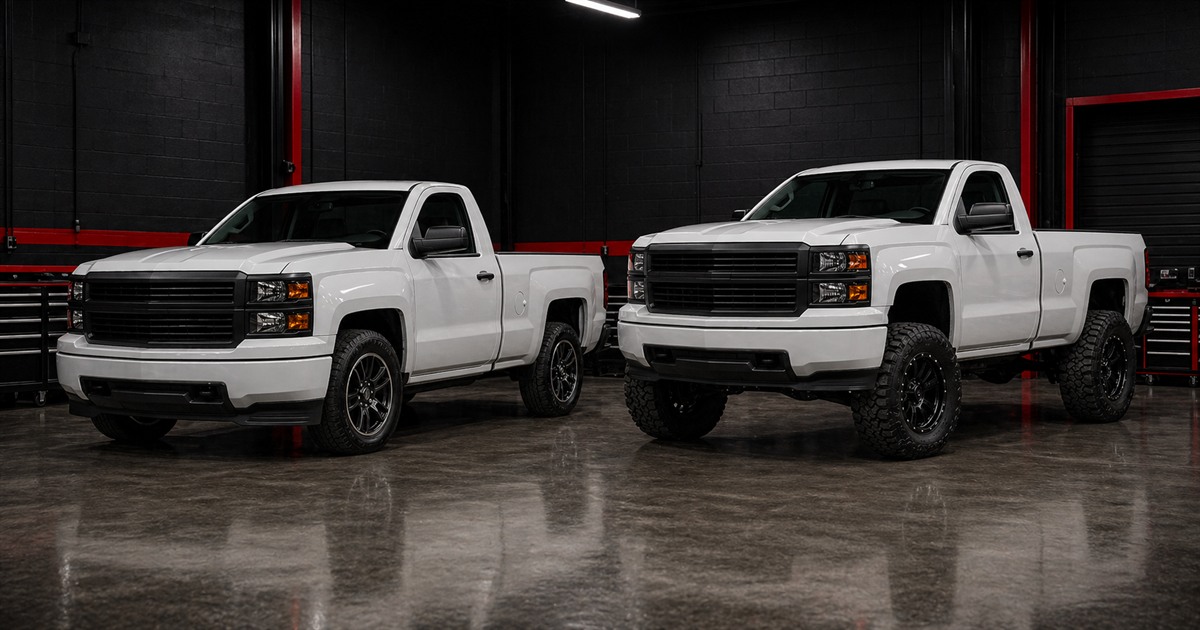
Imagine two customers want the same 6-inch lift height. One drives a 2WD Silverado, and the other drives a 4WD Silverado. From the outside, the finished height may look similar. Underneath, those can be two very different suspension builds.
On a 2WD truck, lift spindles may be used to raise the front while keeping much of the factory suspension geometry in place. A lift spindle does not “stretch” the factory spindle upward. It relocates the wheel hub position on the spindle so the truck body and frame sit higher relative to the wheel.
On a 4WD IFS truck, the kit has to do more than raise the truck. It also has to manage CV axle angles, steering angles, alignment range, differential position, and suspension travel. Larger 4WD lift systems may use lift knuckles, drop crossmembers, differential drop brackets, control arms, shocks or struts, brake line brackets, rear blocks, U-bolts, and other hardware.
That extra engineering is why a 4WD lift often costs more and takes longer to install than a 2WD lift of the same height. If you want a model-specific walkthrough of Chevy options, our best lift kit for Chevy Silverado guide breaks out common choices by generation and drivetrain.
2WD Lift Options: Simplicity and Flexibility
2WD trucks often have more simple lift options than their 4WD counterparts. That is one reason they are a common choice for budget-friendly street trucks and mild lifted builds.
Spindle Lifts
Spindle lifts are one of the most popular options for many 2WD trucks. A lift spindle replaces the factory spindle/steering knuckle and changes the hub location so the truck sits higher while the control arms and spring position stay close to factory. This helps preserve ride quality and steering feel compared with some preload-style lifting methods.
For older trucks like the 88-98 C1500, spindle lifts offer a clean and reliable way to gain front height without a major suspension overhaul. Trekline offers 88-98 C1500 2WD 4-inch lift spindles for common rotor configurations. Always verify cab style, rotor thickness, and fitment before ordering.
Newer 2WD trucks like the 99-06 Silverado/Sierra 1500 can also benefit from spindle lifts. Trekline carries 99-06 Silverado/Sierra 1500 2WD 3-inch lift spindles and other 2WD spindle options depending on the truck.
Spacers
Spacers are simple height-adding parts. Depending on the suspension design, they may sit above a strut assembly, near a coil spring, or in another vehicle-specific position. They are usually inexpensive and quick to install, but they do not create extra suspension travel. On some trucks, pushing spacer height too far can reduce droop travel, make the ride firmer, or make alignment harder.
Blocks and Shackles
Lift blocks are commonly used under the rear leaf spring pack on trucks where the axle is already below the leaf springs. Lift shackles change the rear leaf spring mounting position and can raise the rear slightly. Trekline’s 99-18 Silverado/Sierra 1500 rear lift shackles are a simple way to add a mild rear lift when they fit the application.
4WD Lift Options: Complexity and Engineering
4WD trucks need more planning because the front drivetrain is part of the suspension package. On independent-front-suspension trucks, the kit has to keep the front differential, CV axles, steering, and alignment working together.
Torsion Key Adjustments
Many GM 4WD trucks use torsion bars in the front suspension. A torsion key re-indexes the torsion bar adjustment point so the front ride height can be raised within a controlled range. This method is affordable and common for leveling, but it does not add suspension travel. If the bars are adjusted too far, the truck can lose droop travel, ride firmer, and place more stress on front-end parts.
Trekline’s 99-06 Silverado/Sierra 1500 4WD leveling torsion keys are a common option for mild front-end leveling on those trucks.
Coil-Over Conversion
A coil-over conversion is a more involved upgrade that replaces or changes the factory spring/shock layout. It can improve adjustability and suspension tuning when the system is engineered for the truck, but it is not a shortcut around poor geometry. A larger 4WD build still needs the correct brackets, steering geometry, shock length, brake line clearance, and CV angle management.
Strut Spacers
Many newer IFS trucks use struts or coilover-style assemblies. A strut spacer usually mounts above the strut assembly and adds height by changing the mounted position of the assembly. It is an affordable way to level many trucks, but it can still reduce available droop travel if taken too far. Trekline offers Ram 1500 strut spacers for common 2WD and 4WD applications. On Ford trucks, the corresponding options are covered in our F-150 leveling kit guide.
Longer Coil Springs
Some trucks can be lifted with longer or higher-rate coil springs designed for the application. This can be a good option when matched with the right shocks and alignment parts. The key is choosing a spring that works with the truck’s weight, shock travel, and intended use.
Upper Control Arm Modifications
On many lifted IFS trucks, aftermarket upper control arms are used to improve ball joint angle, increase alignment range, add tire clearance, or restore caster/camber adjustment. Upper control arms are important, but they usually do not directly fix CV axle angle. CV angle correction is more commonly handled through differential drops, drop brackets, vehicle-specific knuckle design, and proper kit geometry. For more detail, read our upper control arms after lift guide.
The CV Angle Problem: Why 4WD Trucks Get Angry at High Lift Heights
CV axles are designed to transfer power while the suspension moves and the wheels turn. They can work at an angle, but they are not meant to run at extreme angles all the time.
When a 4WD IFS truck is lifted without correcting the front-end geometry, the CV axles may sit at a steeper angle than they did from the factory. That can lead to faster CV boot wear, clicking, vibration, binding at full droop, or premature axle failure.
There is no single “safe CV angle” that applies to every truck. The correct range depends on the vehicle, axle design, joint type, lift height, shock length, and how the suspension cycles. That is why a quality 4WD lift should be designed around the specific truck instead of using a one-size-fits-all approach.
Differential Drop Kits: An Essential Part of the 4WD Equation
On many 4WD IFS trucks, the front differential is mounted to the frame or subframe. When the truck is lifted, the frame sits higher relative to the wheel hubs. If the differential stays in the original mounting position, the CV axles may run at a steeper angle.
A differential drop kit lowers the front differential relative to the frame/subframe. This helps reduce CV axle angle, especially at full suspension droop. Not every small leveling kit needs a differential drop, but many taller 4WD lifts either include one or use other brackets designed to keep the front drivetrain geometry in check.
For this reason, differential drop requirements should always be checked by year, make, model, drivetrain, lift height, and the exact parts being installed.
Cost Comparison: Why 2WD Lifts Are Often More Budget-Friendly
Let's talk money. A basic 2WD lift using spindles or spacers might run you $300 to $500 for parts alone, depending on lift height and truck generation. You're looking at straightforward installation with minimal specialized tools.
A 4WD lift starts higher. Torsion key adjustments begin around $66 to $150, but you're limited to 2 to 2.5 inches. For a quality 4-inch 4WD lift, you're likely looking at $600 to $1,200 in parts, potentially more if you need control arms, new shocks, and a differential drop kit. The labor to install a 4WD lift is also typically more intensive.
This cost difference reflects the engineering complexity. 4WD suspension systems are more intricate, and lifting them safely requires more sophisticated parts. You're not just paying for materials; you're paying for engineering that keeps your truck's geometry safe and functional. For the complete breakdown of every price point across height tiers, see our how much does it cost to lift a truck guide.
Which Is Easier to Lift: 2WD Wins for Low-Lift Projects
If you're considering a modest lift of 2 to 4 inches, a 2WD truck is significantly easier to lift. Your options are broader, installation is simpler, and you have less risk of unexpected geometry issues. Many 2WD lift kits are DIY-friendly, though professional installation is always recommended for best results.
4WD trucks, particularly those with independent front suspension, require more careful planning and engineering. Taller levels and lifts may benefit from aftermarket upper control arms when alignment range, tire clearance, or ball joint angle becomes a concern. If you're new to suspension work, a 4WD lift is a job best left to experienced technicians who understand the nuances of CV angle management and differential drop positioning.
For the do-it-yourselfer, 2WD spindle lifts or modest torsion key adjustments on 4WD trucks are the most accessible entry points into the world of lifted suspension. As you get more ambitious - chasing 6 or 8-inch lifts - complexity rises for both platforms, but 4WD trucks reach difficult territory much faster.
Tire Clearance at the Same Lift Height
Two trucks with the same lift height do not always fit the same tire. Tire clearance depends on more than the advertised lift height.
Wheel width, backspacing, offset, tire width, bumper shape, fender liner clearance, control arm clearance, cab mount clearance, and trimming all matter. A 4-inch lift does not automatically mean you can run a tire that is 4 inches taller.
Always check the lift kit’s tire fitment notes and test fit the wheel and tire combination when possible. This is especially important when using wide tires, aggressive offset wheels, or trucks with body style changes inside the same model-year range.
Installation and Maintenance Differences
2WD lift installation is generally straightforward. Spindle swaps involve removing the wheel, brake components, and spindle, then bolting on the new spindle with adjusted steering and brake hardware. Most shops can complete this in 2 to 4 hours per vehicle, depending on complexity and truck age.
4WD lift installation is more involved. Torsion key adjustments are relatively quick - often 1 to 2 hours - but coil-over conversions, strut spacer installations with control arm adjustments, and differential drop work can easily consume 6 to 10 hours or more. This is why labor costs are higher on 4WD lifts.
Maintenance-wise, 2WD lifts are low-drama. You'll do regular suspension checks like you would on any truck: inspect for wear, maintain your shocks, and keep everything tight. 4WD lifts demand more attention to CV angles, differential fluid levels if you've relocated the differential, and brake balance if you've significantly changed your truck's geometry. But with proper installation and periodic checks, both types of lifts are durable and reliable.
Making Your Choice
Choosing between a 2WD and 4WD truck when lift capability is a factor comes down to your specific needs. If you want a lifted appearance and modest capability gains, a 2WD truck offers simplicity, affordability, and plenty of proven solutions. If you need genuine four-wheel-drive traction and plan to lift significantly, the 4WD platform is worth the extra complexity and investment.
Whatever you choose, invest in a quality lift kit from a reputable manufacturer, have it installed by experienced technicians, and maintain your suspension properly. A well-executed lift kit can transform your truck's capability and appearance for years of dependable service. At Trekline Motorsports, we've been assembling suspension solutions for over 20 years, and we're here to help you understand these differences and choose the right kit for your truck.
Frequently Asked Questions
Can I use 4WD lift parts on a 2WD truck?
Generally, no. 4WD lift kits are engineered for a different front-end layout and often include parts that account for a front differential, CV axles, and different steering geometry. Always choose parts designed for your exact year, make, model, drivetrain, and suspension type.
How much does it cost to lift a 2WD truck versus a 4WD truck?
Basic 2WD lift parts often start around a few hundred dollars, while 4WD lifts usually cost more because they may require more parts to manage front drivetrain geometry. For a broader price breakdown, read our truck lift cost guide.
Will lifting my 4WD truck damage my CV axles?
A properly designed and installed 4WD lift should keep CV angles within a reasonable range for the truck. Problems usually happen when the lift height is pushed too far without the correct supporting parts, when shocks allow too much droop, or when the kit is not designed for the vehicle.
What's the difference between a lift kit and a leveling kit?
A leveling kit usually raises the front of the truck to reduce the factory nose-down rake. A lift kit normally raises the front and rear for a taller overall stance and more room for larger tires. A lift kit may improve frame and body clearance, but axle/differential ground clearance usually depends on tire size. Learn more in our lift kit vs leveling kit comparison.
Can I lift my truck myself?
Some smaller bolt-on parts can be installed by experienced DIYers with the correct tools, but suspension work can be dangerous if done incorrectly. Torsion bar systems are under load and require the proper unloading tool. Larger lift kits should be installed by an experienced shop and followed by an alignment.
Do I need a differential drop kit for a 2-inch lift on my 4WD truck?
It depends on the truck and the exact lift design. Many mild leveling kits do not require a differential drop, while taller lifts often do. The safest answer is to follow the lift kit instructions and verify the CV angles at ride height and full droop.
Will a lifted suspension affect my truck's fuel economy?
Usually, yes. A lifted truck may have more wind resistance, added rotating weight from larger tires, and a different effective gear ratio. The exact fuel economy change depends on lift height, tire size, wheel weight, gearing, and driving habits.
How high can I safely lift my 4WD truck without major modifications?
There is no universal safe height. Mild leveling is usually simpler than a full suspension lift, but the limit depends on the truck’s front suspension design, CV axle angles, ball joint angles, steering geometry, and intended use. Once you move beyond mild leveling, a complete vehicle-specific lift system is usually the better route.